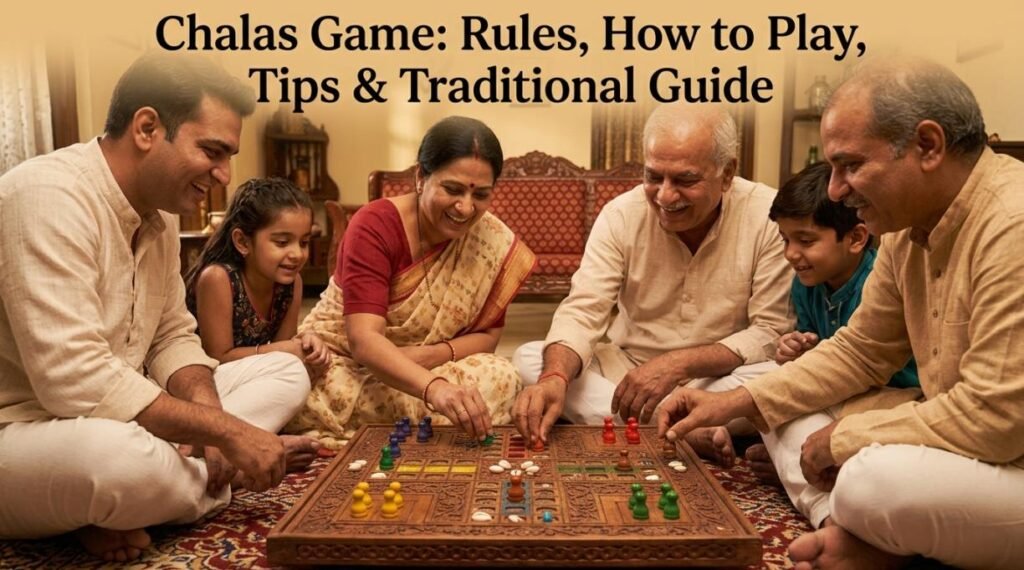

Chalas game is a traditional Indian board game built around a simple idea: move your tokens around a board, capture opposing pieces when possible, and get your tokens to the center before your opponents do.
Although the spelling and rules can vary by region, Chalas is associated with a wider family of Indian cowrie-shell board games. Sources documenting traditional Indian games list Challas among the regional names connected with games such as Chauka Bara and related forms.
Unlike modern Ludo, which usually uses dice, traditional versions of these games commonly use four cowrie shells to determine movement. Different combinations of shells produce different movement values, adding an element of chance while still giving players opportunities to make tactical decisions.
Read More :Timebears com: Features, Uses, Safety & Productivity Guide
What Is Chalas Game?
Chalas game is a traditional race-style board game in which players move a set of tokens around a board toward a central destination. The game belongs to a broad family of Indian board games that have different regional names and rule variations. An archive of traditional Indian board games identifies Challas Aath as a name used in western Maharashtra, while related forms have different names in Karnataka, Kerala, Tamil Nadu, Andhra Pradesh, Telangana, Gujarat, Rajasthan, and other regions.
A modern Chalas game app also describes the game as one involving four coins, cowrie throws, movement around the board, capturing opposing pieces, and reaching a central destination. This means you may encounter slightly different boards or house rules depending on where the game is played.
What You Need to Play Chalas Game
A traditional setup is relatively simple. A documented Chauka Bara rule set, which lists Challas among its alternate names, uses a board, four sets of four pawns, and four cowries.
| Equipment | Typical requirement | Purpose |
| Board | 1 | Provides the movement path |
| Cowrie shells | 4 | Determines movement |
| Tokens | 4 per player | Represents each player’s pieces |
| Players | 2–4 | Compete to reach the destination |
Chalas Game Rules
Chalas rules can vary by regional version or house rule. Therefore, players should agree on the specific rules before beginning.
How Cowrie Shells Determine Movement
Four cowrie shells are traditionally tossed to determine how far a token can move. One documented rule set gives the following values:
1 shell open: move 1 space
2 shells open: move 2 spaces
3 shells open: move 3 spaces
4 shells open: move 4 spaces and receive another throw
No shells open: move 8 spaces and receive another throw
This scoring system is documented for Chauka Bara/Challas-related play. Some modern versions describe the same basic system using the terms 4 and 8 for special throws.
Extra Turns
Special cowrie results can provide another throw. In one documented version, rolling the equivalent of 4 or 8 allows the player to move and then throw again. Capturing another player’s token may also provide an extra turn under traditional rules. Because regional versions differ, it is worth confirming whether your particular Chalas set uses these bonus-turn rules.
Capturing Opponent Tokens
Capturing is one of the strategic parts of the game. When your token lands on a square occupied by an opponent’s token, the opponent’s piece may be captured. In the documented Chauka Bara rules, the captured piece returns to its home position and must travel around the board again.
The capture also gives the player an extra turn. Some modern Challas-style versions specifically require a player to capture an opponent in the outer area before entering the inner area.
Entering the Inner Area
A Chalas-style game generally involves movement through an outer route followed by an inner route toward the center. One documented version says that movement goes anticlockwise through the outer squares and then changes direction in the inner section.
However, this is one area where board designs and local rules can differ. If you are playing a particular physical or digital version, follow the movement diagram supplied with that version.
Reaching the Center
The ultimate objective is to get all of your tokens to the central destination. Modern descriptions of Challas-style Indian Ludo state that each player has four tokens and wins after bringing all of them to the center square.
This makes the game more than a simple race. Players have to decide which token to advance, when to pursue an opponent, and how much risk to take with exposed pieces.
How to Play Chalas Game Step by Step
Set Up the Board
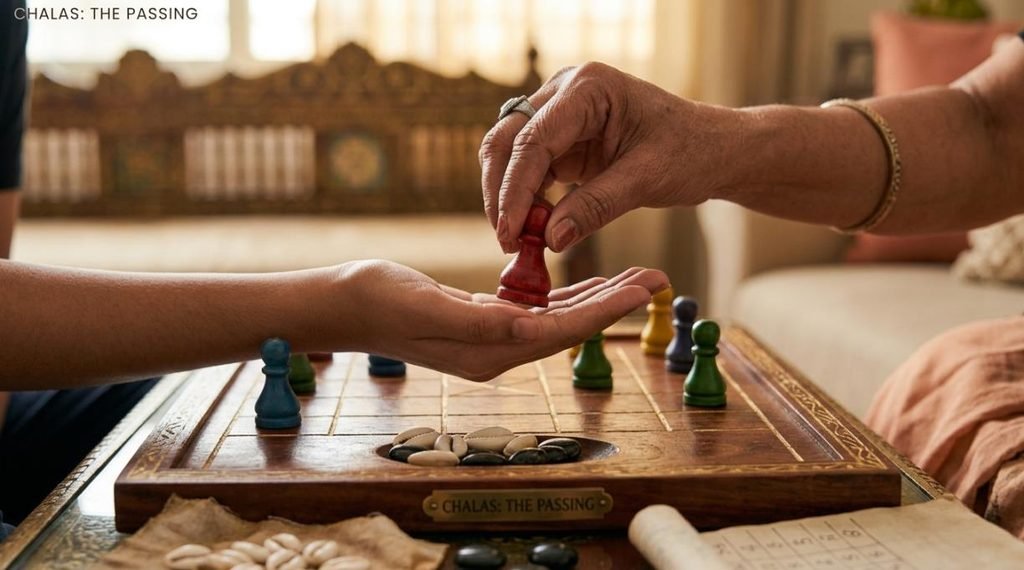
Place the board in the center of the playing area. Each player takes four tokens of the same color and places them in their designated home area. Traditional documented rules use four tokens for each player. Place the four cowrie shells where everyone can reach them.
Start Moving Tokens
Players take turns throwing the four cowries. The number produced by the throw determines how many spaces a token can move. Depending on the version, a player may have a choice of which token to move. If a special throw grants another turn, complete the permitted movement before throwing again.
Capture Opponents
Watch the positions of opposing tokens while planning your move. If your token lands on an opponent’s token and the local rules allow a capture, that token is sent back to its starting area. Traditional rules may reward the capture with another throw.
This creates an important tactical choice: advancing quickly is not always the only useful move.
Move Toward the Center
After meeting the requirements for entering the inner route, guide your tokens toward the center. Some Challas-style rules require at least one opponent token to be captured before a token can enter the inner circle. Pay attention to the exact rules of the version you are playing because this requirement is not necessarily universal across every related Indian board game.
Finish the Game
Continue moving your four tokens until all of them reach the central destination. The player who completes the required objective according to the agreed rules wins.
Chalas Game Scoring and Cowrie Values
The cowrie system is what gives the game its distinctive character. With four cowries, ordinary results can produce movement values of 1, 2, or 3, while special combinations can produce 4 or 8.
In documented versions, the special 4 and 8 results can also grant another throw. Because the result comes from a physical toss, players cannot directly control the number they receive. The strategic element comes from deciding how to use the movement available.
For example: A player may have several possible tokens to move. One option might advance a token closer to the center, while another could place a token in position to capture an opponent.
Chalas Game vs. Ludo
Chalas and modern Ludo share several familiar characteristics, including multiple tokens, a race toward a destination, capturing opponents, and turn-based movement. The major difference is the traditional movement mechanism. Modern Ludo commonly uses a die, whereas Chalas and related traditional Indian games use cowrie shells.
Some versions also have different board layouts and special movement rules. The relationship is not as simple as saying that every Chalas board is identical to Ludo. Traditional Indian board games exist in numerous regional forms, with different names and rule systems. The Indian Boardgames Archive documents these regional variations across multiple parts of India.
So, if you already know Ludo, the basic race-and-capture concept may feel familiar, but the cowrie-based movement and regional rules can make Chalas a distinct experience.
Chalas Game Online and Mobile Versions
You do not necessarily need a physical board to play a modern version. Mobile versions of Challas and related Indian Ludo games have been released with features such as computer opponents, local multiplayer, and online multiplayer. Google Play currently lists an Indian Ludo Ashta Chamma game with computer, local, and online play options.
There are also dedicated Chalas apps. One older Android listing describes Chalas as a board game supporting four players, including combinations of human and computer players. If you choose a digital version, check the app’s rules carefully. A game marketed as Chalas, Challas Aath, Ashta Chamma, or Indian Ludo may use slightly different rules.
Tips for Playing Chalas Better
Good Chalas play is not only about getting lucky with the cowries. Your decisions after each throw also matter.
1. Avoid focusing on only one token.
Moving several tokens can give you more flexibility and reduce the risk of having all your progress concentrated in one piece.
2. Watch your opponents.
Before moving, check whether an opponent is close enough to capture one of your exposed tokens.
3. Use special throws carefully.
A 4 or 8 may give you another turn in many versions. Think about the position you want to create before making the first move.
4. Look for capture opportunities.
If capturing sends an opponent back home and gives you another turn, a capture can significantly change the position of the game.
5. Confirm the house rules first.
Rules surrounding safe squares, inner-circle entry, stacked tokens, and finishing can differ between versions.
Why Chalas Remains Popular

Traditional board games often survive because they are easy to share. Chalas needs relatively little equipment, can accommodate several players, and combines chance with decision-making. The cowrie shells also give it a physical quality that distinguishes it from many modern digital games.
The Indian Boardgames Archive records numerous regional forms of related cowrie-shell games, showing how the same broad game tradition has been adapted under different names and in different communities.
Today, mobile versions make it possible to recreate parts of that experience digitally. Modern apps offer local or online multiplayer alongside computer opponents, allowing the basic concept to reach players who may not have a traditional board at home.
Final Thoughts
Chalas game is a simple but engaging traditional board game built around cowrie-shell throws, token movement, captures, and reaching the center. Its connection with related games such as Chauka Bara, Challas Aath, and Ashta Chamma reflects the wide regional variety of India’s traditional board-game culture.
If you are new to Chalas, start by learning the cowrie scoring system and the movement path, then agree on capture and inner-area rules with the other players. Once those basics are clear, the game becomes easy to follow and much more enjoyable.
FAQs about chalas game
Q1: What is Chalas game?
Ans: Chalas game is a traditional Indian-style race board game that uses tokens and cowrie shells. It is associated with related games known by regional names such as Challas Aath, Chauka Bara, and Ashta Chamma.
Q2: How many players can play Chalas game?
Ans: Many versions support two to four players. A documented Challas-related game setup uses four players, while other versions of the broader game family support two, three, or four players.
Q3: What do you use to play Chalas?
Ans: A traditional setup generally uses a board, four cowrie shells, and four tokens for each player.
Q4: How do you move in Chalas game?
Ans: Players toss four cowrie shells and use the resulting combination to determine movement. Common values are 1, 2, 3, 4, and 8, depending on how the shells land.
Q5: Is Chalas the same as Ludo?
Ans: They are related in gameplay style, but they are not necessarily identical. Chalas and related traditional Indian games use cowrie-shell throws and can have different boards and rules, while modern Ludo generally uses a die.
Q6: Can you capture another player’s token in Chalas?
Ans: Yes, in documented versions, landing on an opponent’s token can capture it and return it to its home position. A capture may also provide an extra turn.
Q7: How do you win Chalas game?
Ans: The common objective is to move all four of your tokens through the board and into the central destination before the other players.