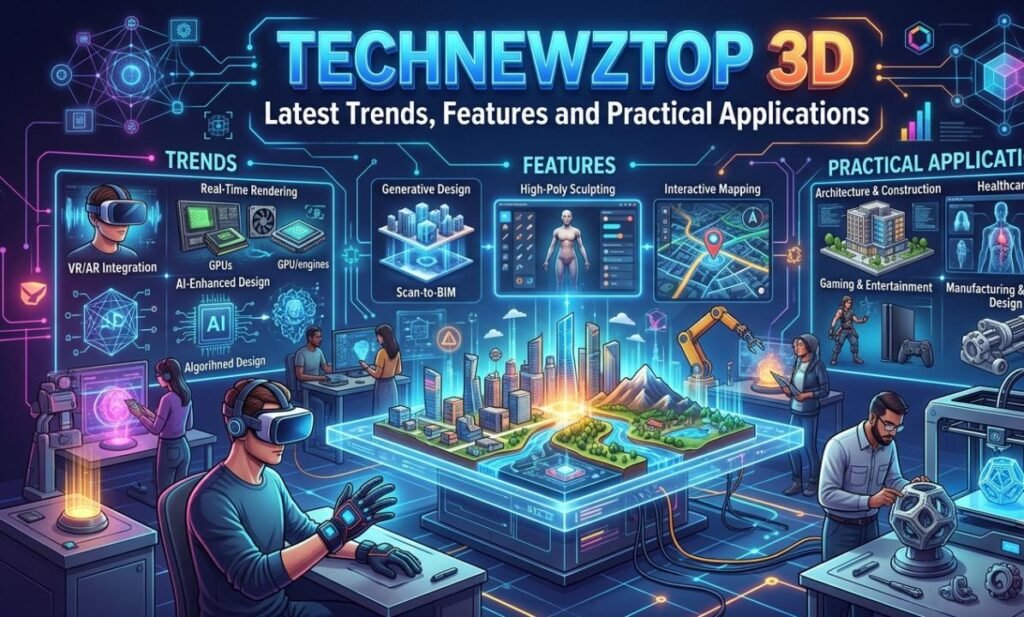

The digital world is evolving rapidly, and three-dimensional (3D) technology has become one of the driving forces behind innovation across industries. From manufacturing and healthcare to gaming, architecture, education, and entertainment, 3D solutions are transforming how people design, build, visualize, and interact with digital content. As interest in these technologies continues to grow, many users search for reliable resources that explain current developments and practical applications.
Technewztop 3d is a topic that attracts readers looking for information about modern 3D technology, emerging trends, and their real-world impact. Reader-focused information based on established knowledge from trusted organizations, universities, industry leaders, and widely accepted technical references. Instead of focusing on speculation, it explains how 3D technology works, where it is used, why it matters, and what trends are shaping its future.
Whether you are a student, business owner, technology enthusiast, designer, developer, or simply curious about 3D innovation, this guide will help you understand the growing influence of modern three-dimensional technologies.
Read more: FTAsiaEconomy Tech Trend: How Emerging Technologies Are Transforming Business
What Is Technewztop 3D?
Definition and Purpose
The term technewztop 3d generally refers to information, news, discussions, and educational content related to modern 3D technologies. Rather than representing a single technology, it encompasses topics such as:
- 3D modeling
- 3D printing
- Computer-generated graphics
- Virtual Reality (VR)
- Augmented Reality (AR)
- Digital visualization
- Engineering design
- Product development
- Interactive media
People searching for technewztop 3d usually want practical information rather than technical jargon. They are interested in understanding how these technologies are applied in everyday life, how industries benefit from them, and what innovations are expected in the coming years.
How Technewztop 3D Fits into Today’s Technology Landscape
Modern businesses rely heavily on visualization, automation, and digital collaboration. Three-dimensional technologies support these goals by enabling professionals to create realistic models before manufacturing physical products. For example:
- Engineers test machine components digitally.
- Doctors prepare for complex surgeries using 3D models.
- Architects present realistic building designs.
- Game developers build immersive virtual environments.
- Manufacturers reduce production costs through rapid prototyping.
These practical applications explain why interest in technewztop 3d continues to grow across multiple industries.
How 3D Technology Works
Understanding the basic principles behind 3D technology helps explain why it has become such an important tool across professional fields.
Three Dimensions Explained
Unlike traditional two-dimensional images that include only height and width, three-dimensional objects include:
- Height
- Width
- Depth
Adding depth allows objects to appear realistic and occupy virtual space similar to physical objects. This realistic representation improves visualization, simulation, and interaction.
The Basic Workflow
Most modern 3D projects follow several common stages:
1. Modeling: Designers create a digital object using specialized software. The object consists of vertices, edges, and polygons that define its shape.
2. Texturing: Materials and colors are applied to make objects appear realistic. Textures may simulate:
- Metal
- Wood
- Fabric
- Glass
- Plastic
- Stone
3. Lighting: Virtual lighting creates realistic shadows and reflections. Proper lighting significantly improves visual quality.
4. Rendering: Rendering converts the digital model into a finished image, animation, or interactive environment. Modern graphics processors (GPUs) have dramatically reduced rendering times compared to previous generations.
Core Technologies Behind 3D
Several technologies work together to create modern 3D experiences.
Computer Graphics: Graphics engines calculate object positions, lighting, and visual effects in real time.
Powerful Hardware: Modern GPUs perform millions of calculations every second to display realistic graphics smoothly.
Specialized Software: Professional applications allow designers to model, animate, simulate, and render complex scenes efficiently.
Artificial Intelligence: AI increasingly assists artists by automating repetitive tasks such as texture generation, object recognition, and animation adjustments.
Different Types of 3D Technologies
The world of 3D technology extends far beyond animation or gaming. Each technology serves a unique purpose.
3D Modeling
3D modeling involves creating digital representations of objects. Applications include:
- Product design
- Industrial engineering
- Interior design
- Architecture
- Character creation
- Mechanical design
3D Printing
Also known as additive manufacturing, 3D printing builds physical objects layer by layer from digital files. According to organizations such as the National Institute of Standards and Technology (NIST), additive manufacturing is widely used for rapid prototyping, customized medical devices, aerospace components, and industrial production.
3D Scanning
3D scanners capture the exact dimensions of physical objects. Industries use scanning for:
- Reverse engineering
- Medical imaging
- Heritage preservation
- Manufacturing quality control
Virtual Reality
Virtual Reality places users inside fully digital environments using head-mounted displays. Common applications include:
- Education
- Medical training
- Flight simulation
- Gaming
- Military training
Augmented Reality
Unlike VR, AR overlays digital information onto the real world. Examples include:
- Interactive navigation
- Product visualization
- Industrial maintenance
- Retail shopping experiences
Mixed Reality
Mixed Reality combines digital and physical environments, allowing users to interact naturally with both. This technology is increasingly used in engineering, healthcare, and collaborative design.
Main Features of Technewztop 3D
Readers searching for technewztop 3d generally expect current, practical, and trustworthy information. Valuable content in this area often includes several important features.
Technology News
The 3D industry changes rapidly. New developments frequently involve:
- Improved rendering software
- Faster graphics hardware
- AI-assisted design
- Better printing materials
- Cloud collaboration
Following industry news helps professionals remain competitive.
Industry Updates
Businesses continuously adopt innovative technologies. Coverage often includes:
- Manufacturing automation
- Healthcare advancements
- Smart construction
- Automotive design
- Aerospace innovation
These updates help readers understand where technology is heading.
Product Reviews
Many professionals compare:
- Graphics cards
- 3D printers
- Modeling software
- VR headsets
- CAD applications
Objective reviews help buyers make informed purchasing decisions.
Educational Content
Beginners benefit from practical tutorials covering:
- Modeling basics
- Printing workflows
- Rendering techniques
- Software comparisons
- Hardware recommendations
Educational resources reduce the learning curve for newcomers.
Emerging Technology Coverage
Modern 3D development increasingly overlaps with:
- Artificial Intelligence
- Machine Learning
- Robotics
- Cloud Computing
- Digital Twins
- Extended Reality (XR)
Understanding these connections provides readers with broader technological knowledge.
Practical Applications of Technewztop 3D
The value of 3D technology becomes clear when examining its widespread use across different sectors.
Manufacturing
Manufacturers use digital prototypes before producing physical products. Benefits include:
- Faster product development
- Lower production costs
- Fewer design errors
- Improved quality testing
Automotive and aerospace companies especially benefit from these capabilities.
Healthcare
Healthcare professionals increasingly use 3D technology for:
- Surgical planning
- Customized implants
- Medical imaging
- Prosthetics
- Anatomical education
Patient-specific models help surgeons prepare for complex procedures with greater confidence.
Architecture and Construction
Architects create highly detailed building models before construction begins. Advantages include:
- Better client presentations
- Improved collaboration
- Early error detection
- Reduced project costs
Building Information Modeling (BIM) has become an important standard in modern construction projects.
Engineering
Engineers rely on 3D visualization throughout product development. Applications include:
- Mechanical design
- Structural analysis
- Simulation
- Testing
- Manufacturing preparation
Digital testing minimizes expensive physical prototypes.
Education
Educational institutions increasingly integrate interactive 3D content into classrooms. Students gain a better understanding of:
- Human anatomy
- Physics
- Chemistry
- Engineering
- Architecture
- Biology
Interactive visualization improves engagement and supports deeper learning compared to static diagrams.
Gaming and Entertainment
The gaming industry has driven many advancements in real-time 3D graphics. Modern game engines create highly detailed virtual worlds with realistic lighting, animation, and physics. These same technologies are now widely used in filmmaking, virtual production, architectural visualization, and product demonstrations.
As graphics hardware becomes more powerful and software continues to evolve, the capabilities highlighted under technewztop 3d will continue expanding into new industries, laying the foundation for the latest trends and innovations discussed in the next section.
Latest Trends in 3D Technology
Three-dimensional technology is advancing faster than ever before. Improvements in computing power, artificial intelligence, cloud infrastructure, and graphics processing have made professional 3D tools more accessible to businesses, educators, and individual creators. Anyone following technewztop 3d should understand these developments because they are shaping the future of digital innovation across industries.
Artificial Intelligence in 3D Design
Artificial Intelligence (AI) is becoming an important part of modern 3D workflows. Instead of replacing designers, AI helps automate repetitive tasks, allowing professionals to spend more time on creativity and problem-solving. AI can assist with:
- Automatic texture generation
- Object recognition
- Image enhancement
- Animation assistance
- Intelligent mesh optimization
- Background removal
- Material recommendations
Many professional software developers are integrating AI-powered tools to improve productivity while maintaining high-quality output.
Real-Time Rendering
Traditional rendering often required hours to generate a single high-quality image. Modern graphics technology now enables real-time rendering, allowing users to see changes instantly while editing. Industries benefiting from real-time rendering include:
- Video game development
- Product design
- Architecture
- Automotive engineering
- Film production
- Virtual events
Real-time visualization speeds up collaboration because designers and clients can review changes immediately.
Cloud-Based Collaboration
Cloud computing has transformed how teams work together on large 3D projects. Instead of storing files on individual computers, organizations now collaborate through secure cloud platforms where multiple users can:
- Edit projects simultaneously
- Review designs remotely
- Share assets instantly
- Manage version history
- Improve workflow efficiency
This approach supports global teams working from different locations.
Digital Twins
A digital twin is a virtual representation of a real-world object, machine, or system. It continuously receives data from sensors, enabling engineers to monitor performance and predict maintenance needs. Digital twins are widely used in:
- Manufacturing
- Smart cities
- Energy management
- Aviation
- Industrial automation
- Healthcare
Organizations use digital twins to reduce downtime, improve operational efficiency, and make better business decisions.
Extended Reality
Extended Reality combines Virtual Reality (VR), Augmented Reality (AR), and Mixed Reality (MR) into one broad category. XR technologies are improving:
- Medical training
- Employee education
- Product visualization
- Engineering simulations
- Retail experiences
- Remote collaboration
As hardware becomes more affordable, XR adoption is expected to increase across many industries.
Sustainable Manufacturing
Environmental sustainability is becoming an important consideration in modern production. Many manufacturers use advanced 3D technologies to:
- Reduce material waste
- Produce lighter products
- Improve production efficiency
- Minimize transportation costs
- Support local manufacturing
Additive manufacturing, commonly known as 3D printing, often produces less waste than traditional subtractive manufacturing methods.
Industries Benefiting Most from 3D Technology
Almost every major industry now relies on three-dimensional technologies to improve productivity, innovation, and customer experiences. The following table summarizes some of the most common applications.
| Industry | Primary Use | Main Benefits |
| Healthcare | Surgical planning, prosthetics, medical imaging | Better patient care and treatment planning |
| Manufacturing | Rapid prototyping, product development | Lower costs and faster production |
| Architecture | Building visualization, BIM | Improved planning and fewer construction errors |
| Engineering | Product simulation and testing | Higher accuracy and reduced design risks |
| Education | Interactive teaching models | Better student engagement and understanding |
| Gaming | Character creation and virtual environments | More immersive user experiences |
| Automotive | Vehicle design and testing | Faster innovation and improved safety |
| Aerospace | Component development and simulation | Precision engineering and weight optimization |
Popular 3D Software and Tools
Professionals use different software depending on project requirements. Some applications focus on engineering, while others specialize in animation, visualization, or game development.
Blender
Blender is one of the world’s most popular open-source 3D creation tools. It supports:
- Modeling
- Animation
- Sculpting
- Rendering
- Video editing
- Motion tracking
Its active community and continuous updates make it suitable for beginners and professionals alike.
Autodesk Maya
Autodesk Maya is widely used in:
- Film production
- Television
- Visual effects
- Character animation
Its advanced animation tools make it an industry standard for entertainment projects.
SolidWorks
SolidWorks focuses primarily on mechanical engineering and product development. Engineers use it for:
- CAD modeling
- Product simulation
- Mechanical assemblies
- Manufacturing preparation
AutoCAD
AutoCAD remains one of the most recognized Computer-Aided Design (CAD) applications. Professionals in architecture, engineering, and construction use it to produce accurate technical drawings and 3D models.
Unreal Engine
Originally designed for video games, Unreal Engine now supports:
- Film production
- Virtual production
- Architecture
- Automotive visualization
- Interactive presentations
Its realistic lighting capabilities have made it popular beyond gaming.
Unity
Unity is another widely adopted real-time development platform. Applications include:
- Mobile games
- VR applications
- AR experiences
- Educational simulations
- Industrial visualization
Tinkercad
Tinkercad is beginner-friendly software commonly used in schools and introductory design courses. Its simple interface allows users to learn basic modeling concepts before moving to more advanced software.
Common Challenges of Using 3D Technology
Although modern tools are becoming more accessible, organizations still face several challenges.
High Initial Investment
Professional workstations, graphics cards, scanners, and industrial 3D printers often require significant financial investment. Small businesses must carefully evaluate return on investment before purchasing specialized equipment.
Learning Curve
Professional software includes hundreds of advanced features. Learning:
- Modeling
- Animation
- Rendering
- Simulation
- CAD design
takes time, practice, and ongoing education.
Hardware Requirements
Large 3D projects consume considerable computing resources. Users often require:
- Powerful processors
- Dedicated graphics cards
- Large memory capacity
- Fast storage drives
Insufficient hardware can slow production considerably.
Software Compatibility
Organizations frequently use multiple software platforms. Converting files between programs sometimes creates issues such as:
- Missing textures
- Geometry errors
- Unsupported features
- Data loss
Standardized file formats help reduce compatibility problems.
Cybersecurity
As cloud collaboration increases, organizations must protect valuable intellectual property. Important security measures include:
- Multi-factor authentication
- Regular software updates
- Secure cloud storage
- Data encryption
- Access control policies
Protecting sensitive design files is becoming increasingly important.
Best Practices for Working with 3D Technology
Following established best practices improves productivity while reducing errors.
Choose the Right Software
Not every application serves the same purpose. For example:
- Engineers typically require CAD software.
- Artists often prefer animation software.
- Architects rely on BIM solutions.
- Game developers use real-time engines.
Selecting appropriate tools improves efficiency.
Maintain Organized Project Files
Proper file organization prevents confusion during complex projects. Recommended practices include:
- Clear folder structures
- Consistent naming conventions
- Regular backups
- Version control
Good organization reduces project delays.
Continue Learning
Technology changes rapidly. Professionals benefit from:
- Online courses
- Industry certifications
- Technical documentation
- Academic publications
- Professional communities
Continuous learning keeps skills current.
Verify Information Using Trusted Sources
Reliable technical knowledge should come from authoritative organizations such as:
- Universities
- Government agencies
- Industry standards organizations
- Professional software documentation
- Peer-reviewed research
Using verified information improves both credibility and decision-making.
Focus on User Needs
Whether creating products, educational content, or business solutions, successful projects prioritize usability rather than unnecessary technical complexity. Designing with end users in mind leads to better outcomes.
Common Myths About 3D Technology
As technewztop 3d continues to gain attention, several misconceptions persist. Separating myths from facts helps readers make informed decisions.
1: 3D Technology Is Only for Large Companies
This is no longer true. Affordable software, cloud services, and entry-level 3D printers have made the technology accessible to freelancers, educators, startups, and small businesses.
2: 3D Printing Can Produce Anything
While 3D printing is highly versatile, it has limitations related to material properties, production speed, size constraints, and manufacturing costs. Traditional manufacturing remains the better choice for many large-scale production needs.
3: Learning 3D Design Is Too Difficult
Professional expertise requires time and practice, but many beginner-friendly tools, tutorials, and online learning resources make it easier than ever to start building practical skills.
4: Only Engineers Use 3D Technology
Today, 3D tools are used by architects, healthcare professionals, teachers, filmmakers, game developers, marketers, fashion designers, researchers, and many other professionals. The growing range of applications demonstrates that 3D technology is no longer limited to engineering alone. As innovations continue to reshape industries, staying informed about technewztop 3d can help individuals and organizations recognize new opportunities, adopt effective technologies, and prepare for the next generation of digital transformation.
Conclusion
Keeping up with rapid advancements in 3D technology can be challenging. With countless online sources sharing outdated, incomplete, or inaccurate information, many individuals and businesses struggle to identify practical solutions that truly add value. that challenge by providing a clear, fact-based explanation of technewztop 3d, covering its latest trends, core features, real-world applications, industry use cases, software tools, benefits, and future direction.
The purpose of this guide is to help readers make informed decisions based on reliable information rather than speculation. By applying the knowledge shared here and continuing to follow trusted industry sources, you can confidently embrace 3D technology and stay prepared for the next wave of digital innovation.
FAQs about technewztop 3d
Q1: What is technewztop 3d?
Ans: Technewztop 3d refers to content focused on modern 3D technology, including industry trends, software, practical applications, digital innovation, and emerging developments across various sectors.
Q2: Which industries benefit the most from 3D technology?
Ans: Healthcare, manufacturing, architecture, engineering, education, gaming, automotive, aerospace, and entertainment are among the industries that benefit most from 3D technology. They use it for visualization, product development, simulation, training, and improved operational efficiency.
Q3: Is 3D technology suitable for beginners?
Ans: Yes. Many beginner-friendly tools, online tutorials, and educational platforms make it easier to learn 3D modeling and design. Starting with simple projects and gradually developing advanced skills is the most effective learning approach.
Q4: What is the difference between 3D modeling and 3D printing?
Ans: 3D modeling is the process of creating a digital object using specialized software, while 3D printing converts that digital model into a physical object by building it layer by layer using appropriate materials.
Q5: How does artificial intelligence improve 3D technology?
Ans: Artificial intelligence helps automate repetitive tasks, improve rendering efficiency, generate textures, optimize models, assist with animation, and streamline creative workflows, allowing designers to work more efficiently.
Q6: What software is commonly used for 3D design?
Ans: Popular 3D software includes Blender, Autodesk Maya, AutoCAD, SolidWorks, Unity, Unreal Engine, and Tinkercad. Each application is designed for different use cases, ranging from animation and game development to engineering and architectural design.
Q7: What are the latest trends in 3D technology?
Ans: Current trends include AI-assisted design, real-time rendering, cloud-based collaboration, digital twins, extended reality (XR), sustainable manufacturing, and increasingly realistic visualization techniques that improve productivity across industries.
Q8: Why is staying updated with technewztop 3d important?
Ans: Following technewztop 3d helps readers stay informed about new technologies, software improvements, industry best practices, and practical applications. Keeping up with these developments enables individuals and organizations to make informed decisions, improve skills, and adapt to ongoing technological advancements.