

In today’s fast-changing digital economy, technology is no longer just a support function—it has become the driving force behind business growth, innovation, and long-term competitiveness. Organizations across industries are embracing artificial intelligence (AI), cloud computing, big data, automation, blockchain, and the Internet of Things (IoT) to improve efficiency, enhance customer experiences, and create new revenue opportunities. As these technologies continue to evolve, understanding the ftasiaeconomy tech trend has become increasingly important for business leaders, entrepreneurs, investors, and technology enthusiasts.
The ftasiaeconomy tech trend reflects the growing influence of emerging technologies on businesses and economies, particularly within Asia’s rapidly expanding digital landscape. It highlights how companies are adapting to technological advancements to remain competitive in both local and global markets. Whether it’s AI-powered customer support, cloud-based collaboration, or data-driven decision-making, these innovations are transforming how organizations operate.
Explores the latest developments shaping the ftasiaeconomy tech trend, explains why they matter, and provides practical insights into how businesses can prepare for the future. From foundational concepts to real-world applications, you’ll gain a comprehensive understanding of the technologies redefining today’s business environment.
Read more: Assotech Business Cresterra: Location, Offices & Amenities
Understanding the FTAsiaEconomy Tech Trend
The ftasiaeconomy tech trend refers to the collection of emerging technologies, digital innovations, and business transformation strategies that are influencing economic growth and organizational success. Rather than focusing on a single technology, it encompasses a broad range of developments that help companies improve productivity, reduce operational costs, and respond to changing customer expectations.
Businesses today operate in an environment where technology evolves at an unprecedented pace. Companies that recognize these changes early often gain a competitive advantage by adopting innovative solutions before their competitors. This proactive approach enables organizations to optimize processes, increase efficiency, and identify new market opportunities.
Why Businesses Monitor Technology Trends
Keeping up with technological change is no longer optional. Businesses that fail to adapt risk falling behind competitors who embrace innovation. Some of the key reasons organizations monitor the ftasiaeconomy tech trend include:
- Improving operational efficiency
- Reducing manual workloads through automation
- Enhancing customer satisfaction
- Identifying new business opportunities
- Strengthening cybersecurity defenses
- Supporting data-driven decision-making
- Preparing for future market changes
Technology’s Role in Economic Growth
Technology has become one of the strongest drivers of economic development. Digital infrastructure enables businesses to reach global customers, improve communication, and access information instantly. Governments and private organizations increasingly invest in digital transformation initiatives because technological innovation contributes to:
- Higher productivity
- Greater business competitiveness
- Increased employment opportunities
- Faster innovation cycles
- Sustainable economic development
Why the FTAsiaEconomy Tech Trend Matters
Ftasiaeconomy tech trend helps organizations make informed decisions about future investments, workforce development, and digital transformation strategies. Several factors explain why this trend has become increasingly significant.
Driving Business Innovation
Innovation is essential for long-term success. Companies that invest in emerging technologies often discover new ways to serve customers, improve products, and optimize internal processes. For example, retailers now use AI-powered recommendation engines to personalize shopping experiences, while manufacturers employ predictive maintenance systems to reduce equipment downtime. Innovation enables businesses to stay relevant even as customer expectations evolve.
Supporting Smarter Decision-Making
Modern businesses generate enormous amounts of data every day. Without effective analysis, much of this information remains unused.Advanced analytics and artificial intelligence transform raw data into meaningful insights by identifying patterns, forecasting trends, and supporting strategic planning. Instead of relying solely on intuition, executives can make evidence-based decisions that reduce risk and improve performance.
Creating Better Customer Experiences
Customers increasingly expect personalized, convenient, and responsive services. Businesses now leverage technologies such as:
- AI chatbots
- Customer relationship management (CRM) systems
- Predictive analytics
- Mobile applications
- Cloud platforms
Improving Operational Efficiency
One of the biggest advantages of following the ftasiaeconomy tech trend is increased operational efficiency. Automation eliminates repetitive tasks that previously consumed valuable employee time. Examples include:
- Invoice processing
- Inventory tracking
- Customer support
- Appointment scheduling
- Document management
Major Technologies Shaping the FTAsiaEconomy Tech Trend
Several emerging technologies play a significant role in modern business transformation. Each contributes differently depending on an organization’s industry, goals, and digital maturity.
Artificial Intelligence
Artificial intelligence has become one of the most influential technologies shaping today’s business environment. AI enables computer systems to perform tasks that traditionally required human intelligence, including:
- Speech recognition
- Image analysis
- Language translation
- Customer support
- Data analysis
- Recommendation systems
Practical Example
An online retailer uses AI algorithms to recommend products based on browsing history and previous purchases. Benefits include:
- Higher sales
- Improved customer satisfaction
- Increased engagement
- Better product discovery
Machine Learning
Machine learning is a branch of artificial intelligence that allows systems to improve automatically through experience. Rather than following fixed instructions, machine learning models identify patterns within data and continuously refine predictions. Businesses apply machine learning to:
- Fraud detection
- Demand forecasting
- Marketing optimization
- Predictive maintenance
- Customer segmentation
Cloud Computing
Cloud computing has fundamentally changed how organizations store data and access software. Instead of relying on expensive physical servers, businesses now use cloud platforms to access computing resources on demand. Benefits include:
- Lower infrastructure costs
- Flexible scalability
- Improved collaboration
- Remote accessibility
- Automatic software updates
Big Data Analytics
Every interaction, transaction, and digital activity generates valuable information. Big data analytics helps organizations process massive volumes of structured and unstructured data to uncover trends that would otherwise remain hidden. Businesses use analytics to:
- Understand customer preferences
- Improve marketing campaigns
- Forecast sales
- Reduce operational costs
- Enhance strategic planning
Internet of Things (IoT)
The Internet of Things connects physical devices to the internet, allowing them to collect, exchange, and analyze data automatically. Examples include:
- Smart factories
- Connected vehicles
- Wearable health devices
- Smart agriculture systems
- Intelligent energy management
Blockchain Technology
Blockchain extends beyond cryptocurrency. It offers a secure and transparent method of recording transactions that cannot easily be altered. Businesses increasingly adopt blockchain for:
- Supply chain transparency
- Digital identity verification
- Cross-border payments
- Contract management
- Asset tracking
Cybersecurity: A Critical Foundation
As organizations adopt more digital technologies, cybersecurity becomes increasingly important. Cyber threats continue to evolve, targeting businesses of all sizes through ransomware, phishing attacks, and data breaches. Modern cybersecurity strategies include:
- Multi-factor authentication
- Endpoint protection
- Zero-trust security models
- Employee awareness training
- Continuous monitoring
- Regular security audits
Industries Being Transformed by the FTAsiaEconomy Tech Trend
The influence of the ftasiaeconomy tech trend extends across nearly every sector of the economy. While each industry adopts technology differently, the common goal is to improve efficiency, reduce costs, enhance customer experiences, and remain competitive in an increasingly digital marketplace. Businesses that embrace innovation are often better equipped to adapt to changing market demands and create sustainable growth.
Banking and FinTech
The financial sector has experienced one of the most significant digital transformations over the past decade. Traditional banking services are rapidly evolving as customers demand faster, safer, and more convenient financial solutions.
Artificial intelligence helps banks detect fraudulent transactions in real time by analyzing unusual spending patterns. Mobile banking applications allow customers to transfer funds, apply for loans, and manage investments without visiting a physical branch.
Blockchain technology is also improving payment systems by making cross-border transactions more transparent and efficient. Meanwhile, cloud computing enables financial institutions to scale their services securely while reducing infrastructure costs.
Practical Example
A digital bank can use AI to instantly assess loan applications based on credit history, income, and spending habits. Instead of waiting several days for approval, customers may receive decisions within minutes, improving satisfaction while reducing administrative work.
Healthcare
Healthcare organizations increasingly rely on digital technologies to improve patient care, reduce medical errors, and optimize hospital operations. Electronic health records allow healthcare providers to access patient information quickly and securely. AI-powered diagnostic tools help doctors identify diseases earlier by analyzing medical images with impressive accuracy.
Wearable devices connected through the Internet of Things (IoT) continuously monitor heart rate, blood pressure, sleep quality, and physical activity. This data helps physicians detect health issues before they become serious.
Retail and E-commerce
Retail businesses have transformed dramatically as online shopping continues to grow. Artificial intelligence now powers personalized product recommendations based on browsing history and previous purchases. Retailers use predictive analytics to forecast demand, helping them maintain optimal inventory levels while minimizing waste. Smart warehouses equipped with automation technology improve order fulfillment by reducing manual handling and shipping delays.
Augmented reality applications allow customers to virtually try clothing, visualize furniture inside their homes, or preview cosmetic products before making purchases. Together, these technologies create a smoother shopping experience while helping businesses improve profitability.
Manufacturing
Modern manufacturing increasingly depends on automation, robotics, and intelligent monitoring systems. Factories equipped with IoT sensors continuously collect information about machine performance, energy consumption, and production quality. Predictive maintenance systems analyze this data to identify equipment problems before failures occur, reducing costly downtime.
Robotic automation performs repetitive assembly tasks with greater precision, allowing employees to focus on quality control and process improvement. This shift toward smart manufacturing illustrates how the ftasiaeconomy tech trend supports productivity and operational excellence.
Education
Educational institutions are embracing digital learning platforms to make education more flexible and engaging. Cloud-based learning management systems allow students to access lessons anytime and from anywhere. Artificial intelligence personalizes learning experiences by recommending educational content based on individual progress and learning styles.
Interactive technologies such as virtual reality also enhance practical learning by simulating laboratory experiments, medical procedures, and engineering projects.
Logistics and Supply Chain
Supply chain management has become increasingly data-driven. Businesses now use GPS tracking, IoT sensors, and predictive analytics to monitor shipments in real time. Artificial intelligence optimizes delivery routes, reducing transportation costs while improving delivery speed.
Blockchain improves supply chain transparency by recording every transaction from production to final delivery, helping organizations verify product authenticity and reduce fraud. These innovations create more resilient and efficient global supply chains.
Benefits of Following the FTAsiaEconomy Tech Trend
Organizations that actively monitor the ftasiaeconomy tech trend are better prepared to adapt to changing technologies and customer expectations. Some of the most significant benefits include:
Better Decision-Making
Advanced analytics transform raw business data into meaningful insights. Managers can monitor customer behavior, identify market trends, evaluate business performance, and make evidence-based decisions rather than relying solely on assumptions.
Higher Productivity
Automation handles repetitive administrative tasks such as invoice processing, scheduling, payroll, and inventory management. Employees gain more time to focus on innovation, customer relationships, and strategic planning.
Lower Operational Costs
Cloud computing reduces hardware expenses. Predictive maintenance minimizes equipment repairs. Automation lowers labor-intensive workloads. Digital collaboration tools reduce travel and communication costs. Together, these improvements contribute to long-term financial savings.
Improved Customer Experience
Technology enables organizations to deliver faster, more personalized services.Customers benefit from:
- Faster support
- Personalized recommendations
- Mobile accessibility
- Secure online transactions
- Improved communication
Competitive Advantage
Companies that adopt innovative technologies early often respond more quickly to market changes.
They introduce new products faster, optimize operations more effectively, and better anticipate customer needs.
Professional Comparison Table
| Technology | Primary Business Benefit | Example Application |
| Artificial Intelligence | Automation and smarter decisions | Customer support chatbots |
| Machine Learning | Predictive insights | Fraud detection |
| Cloud Computing | Scalability and flexibility | Remote collaboration |
| Big Data Analytics | Business intelligence | Sales forecasting |
| Internet of Things (IoT) | Real-time monitoring | Smart manufacturing |
| Blockchain | Secure recordkeeping | Supply chain tracking |
| Cybersecurity | Data protection | Threat detection and prevention |
Challenges Businesses Must Overcome
Although emerging technologies offer tremendous opportunities, successful implementation requires careful planning.
High Initial Investment
Digital transformation often involves purchasing software, upgrading infrastructure, training employees, and redesigning business processes. Small businesses may find these upfront costs challenging.
Recommendation: Start with cloud-based subscription services that require lower initial investment and expand gradually as the business grows.
Skills Gap
Many organizations struggle to recruit professionals with expertise in artificial intelligence, cybersecurity, data science, and cloud computing. Without the right skills, technology investments may not deliver expected results.
Recommendation: Invest in continuous employee training, online certification programs, and partnerships with educational institutions.
Cybersecurity Risks
The increasing number of connected devices creates additional opportunities for cybercriminals. Common threats include:
- Phishing attacks
- Data breaches
- Malware
- Insider threats
- Ransomware
Recommendation: Adopt a layered cybersecurity strategy that includes employee awareness training, strong authentication methods, regular software updates, and continuous security monitoring.
Resistance to Organizational Change
Employees sometimes hesitate to adopt new technologies because they fear job displacement or feel uncomfortable learning unfamiliar systems. Poor communication during digital transformation often increases resistance.
Recommendation: Clearly explain how technology supports employees rather than replacing them. Provide practical training and involve staff in the implementation process.
Data Privacy and Compliance:Businesses must comply with data protection regulations while collecting and processing customer information. Poor data governance may lead to legal penalties and reputational damage.
Recommendation: Develop transparent privacy policies, regularly review compliance requirements, and encrypt sensitive information whenever possible.
Practical Strategies for Successful Technology Adoption
Organizations that succeed with digital transformation usually follow a structured approach instead of chasing every new innovation. Some practical strategies include:
Develop a Clear Digital Strategy: Technology investments should support measurable business objectives rather than simply following industry trends.
Prioritize Customer Needs: Evaluate how each technology improves customer satisfaction before implementation.
Start with Pilot Projects: Testing new technologies on a small scale reduces financial risk while providing valuable learning opportunities.
Measure Performance: Track important metrics such as productivity, customer satisfaction, operational costs, and return on investment.
Encourage Continuous Learning: Technology evolves rapidly. Businesses should promote lifelong learning through workshops, certifications, and knowledge-sharing sessions.
Future Outlook of the FTAsiaEconomy Tech Trend
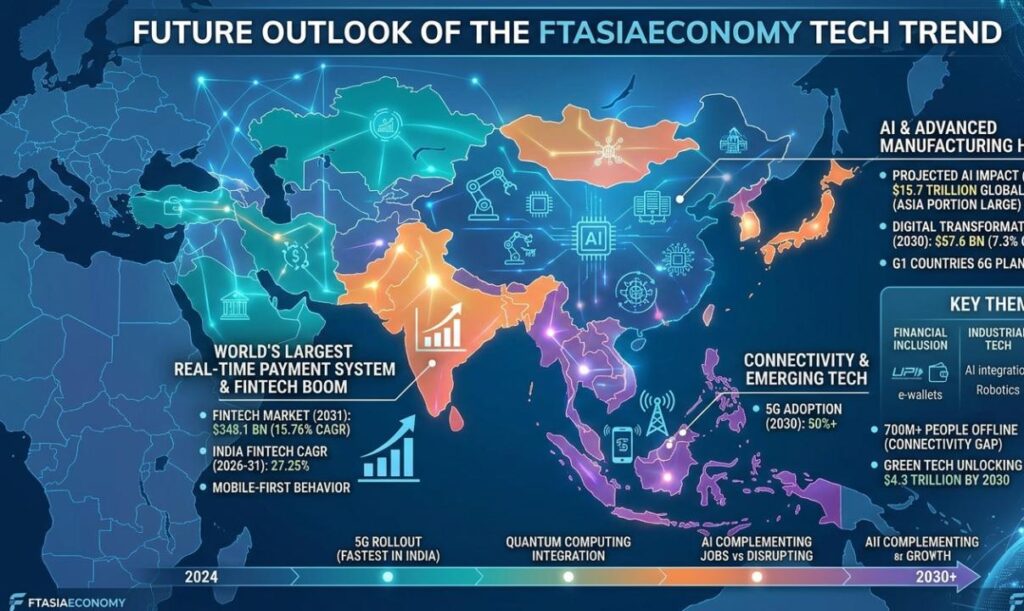
The pace of technological innovation shows no signs of slowing down. As businesses continue investing in digital transformation, the ftasiaeconomy tech trend will increasingly focus on intelligent automation, sustainable innovation, and data-driven decision-making.
Companies that remain adaptable and embrace continuous learning will be better positioned to respond to changing customer expectations and global market conditions.Several technologies are expected to play an even greater role in the coming years:
Artificial Intelligence Will Become More Accessible
AI tools are becoming more affordable and easier to implement. Small and medium-sized businesses that once lacked the resources for advanced technologies can now use AI-powered solutions for customer service, marketing, sales forecasting, and operational efficiency.
Sustainability Will Drive Innovation
Businesses are placing greater emphasis on environmentally responsible practices. Smart energy management systems, green data centers, and AI-powered resource optimization are helping organizations reduce costs while lowering their environmental impact.
Automation Will Expand Across Industries
Automation will continue replacing repetitive manual tasks, allowing employees to focus on creative thinking, strategic planning, and customer engagement. Rather than eliminating jobs entirely, automation is expected to reshape roles by increasing the demand for digital and analytical skills.
Data Will Become a Strategic Asset
Organizations that effectively collect, analyze, and protect data will gain a competitive advantage. Businesses will increasingly rely on predictive analytics to anticipate customer behavior, optimize operations, and identify new market opportunities.
Expert Recommendations for Businesses
Successfully navigating the ftasiaeconomy tech trend requires more than simply purchasing new technology. Organizations should build a long-term strategy that aligns digital investments with business objectives. Experts generally recommend the following best practices:
- Create a clear digital transformation roadmap.
- Invest in employee training and continuous learning.
- Strengthen cybersecurity before adopting new technologies.
- Focus on solving real business problems instead of following every new trend.
- Measure technology investments using clear performance indicators.
- Encourage collaboration between business leaders and IT teams.
- Stay informed about emerging technologies and industry developments.
Conclusion
Technology continues to redefine how businesses operate, compete, and grow in an increasingly connected world. The ftasiaeconomy tech trend demonstrates that innovation is no longer optional—it is a critical factor for long-term success. From artificial intelligence and cloud computing to blockchain, cybersecurity, and big data analytics, emerging technologies are helping organizations improve efficiency, make smarter decisions, and deliver greater value to customers.
However, successful digital transformation requires more than adopting the latest tools. Businesses need a clear strategy, skilled employees, strong data governance, and a willingness to embrace continuous improvement. Organizations that focus on solving real business challenges rather than simply following trends are more likely to achieve sustainable growth.
As technology continues to evolve, staying informed about the ftasiaeconomy tech trend will help business leaders identify new opportunities, reduce risks, and build resilient organizations capable of thriving in the digital economy. By combining innovation with thoughtful planning, companies of all sizes can turn technological change into a lasting competitive advantage.
FAQs about FTAsiaEconomy Tech Trend
Q1: What is the FTAsiaEconomy tech trend?
Ans: The ftasiaeconomy tech trend refers to emerging technologies and digital innovations that influence business growth, economic development, and digital transformation. It covers areas such as artificial intelligence, cloud computing, blockchain, cybersecurity, big data, and automation.
Q2: Why is the FTAsiaEconomy tech trend important for businesses?
Ans: It helps businesses understand technological changes, improve operational efficiency, enhance customer experiences, reduce costs, and remain competitive in rapidly evolving markets.
Q3: Which industries benefit the most from emerging technologies?
Ans: Banking, healthcare, manufacturing, retail, logistics, education, finance, and e-commerce are among the industries experiencing significant benefits from digital transformation and emerging technologies.
Q4: How does artificial intelligence support business growth?
Ans: AI automates repetitive tasks, analyzes large volumes of data, improves customer service through chatbots, predicts market trends, and helps organizations make faster and more informed decisions.
Q5: What are the biggest challenges of adopting new technologies?
Ans: Common challenges include high implementation costs, cybersecurity risks, employee skill gaps, resistance to organizational change, and maintaining compliance with data privacy regulations.
Q6: Can small businesses benefit from the FTAsiaEconomy tech trend?
Ans: Yes. Affordable cloud services, AI-powered software, digital marketing tools, and automation platforms enable small businesses to improve productivity, compete effectively, and expand without major infrastructure investments.
Q7: How can businesses prepare for future technology trends?
Ans: Organizations should monitor industry developments, invest in workforce training, adopt scalable digital solutions, strengthen cybersecurity, and regularly evaluate their technology strategy to remain competitive.



Pingback: “Newsgiga com – Latest News, Updates & Online Stories”