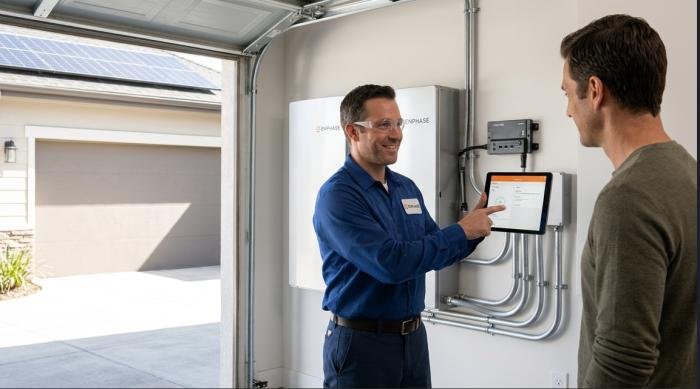

The demand for reliable home energy storage is growing as homeowners seek better ways to manage electricity costs, use solar power efficiently, and prepare for unexpected power outages. The Enphase battery offers a smart energy storage solution that helps homeowners store excess solar electricity and use it when energy demand increases or sunlight is unavailable.
By combining compatible solar equipment with battery storage and energy monitoring, homeowners can gain greater control over their electricity usage while reducing their dependence on the utility grid. Whether the goal is to power essential appliances during an outage or make better use of daytime solar production, an Enphase battery can be a valuable addition to a well-designed home energy system.
What Is an Enphase Battery?
An Enphase battery is a residential energy storage solution designed to store electricity and make it available when a home needs power. Depending on the model and system configuration, it can work with a solar installation, a compatible Enphase energy management system, and the electrical equipment required to manage charging and discharging.
During sunny hours, solar panels may generate more electricity than a household is using. Instead of sending all the excess electricity to the grid, a compatible system can direct some of that energy into the battery. When solar production decreases in the evening or during cloudy weather, the stored electricity can help supply household demand.
Read More: Contractor for Home Renovation: Professional Renovation Services
A battery may also provide backup power during a grid outage when the installation includes the appropriate backup equipment and has been configured for that purpose. However, not every solar-plus-battery installation automatically provides whole-home backup. The supported loads, available battery energy, inverter capabilities, and electrical design determine what can continue operating during an outage.
Enphase offers different generations and configurations of battery products, so the exact specifications depend on the model available in the homeowner’s market. Before buying, it is important to check the manufacturer’s current product documentation and confirm compatibility with the existing solar system.
Enphase Battery at a Glance
The following table summarizes the main features homeowners should consider when evaluating an Enphase battery system.
| Feature | What homeowners should know |
| Product range | Enphase IQ Battery models, including the IQ Battery 5P and IQ Battery 10C |
| Energy storage | Capacity depends on the selected model; the IQ Battery 5P offers 5 kWh of usable energy |
| Power output | Varies by model and configuration; the IQ Battery 5P supports up to 3.84 kW continuous output in single-phase operation |
| Battery chemistry | Lithium iron phosphate (LFP) in the models discussed here |
| Solar compatibility | Depends on the battery generation, inverter equipment, and system design |
| Backup capability | Requires compatible backup equipment and an appropriately designed installation |
| Energy management | Compatible systems support monitoring and energy-use management through the Enphase App |
| Installation | Professional assessment and installation are recommended |
| Warranty | Terms vary by product, market, and applicable warranty documentation |
How Does an Enphase Battery Work?
An Enphase battery works by storing electricity when it is available and delivering that energy when household demand increases or solar production decreases. Its operation depends on the connected solar equipment, battery model, system controller, and selected energy-management settings.
1. Solar Panels Generate Electricity
During daylight hours, solar panels convert sunlight into electrical energy. The electricity generated can power appliances such as refrigerators, lights, computers, fans, and other household devices.
If solar production is greater than immediate household demand, the system may have excess energy available for storage. Without a battery, that surplus may be exported to the utility grid, depending on the installation and local rules.
2. Excess Electricity Charges the Battery
When the system detects available surplus energy, it can direct electricity into the battery. The stored energy is measured in kilowatt-hours (kWh), which indicates how much energy the battery can hold.
Charging behavior depends on system configuration, battery availability, the household’s electricity consumption, and any reserve settings. Some homeowners may prioritize charging the battery before exporting electricity, while others may use settings that balance solar self-consumption and grid interaction.
3. Stored Energy Powers the Home
When solar panels generate less electricity than the household needs, the battery can discharge to supply part of that demand. This often happens in the evening, when people return home and switch on lights, cooking appliances, televisions, and other devices.
Using stored solar energy can reduce the amount of electricity purchased from the grid. The actual savings depend on the home’s energy consumption, battery size, system efficiency, local electricity tariffs, and the compensation available for exported solar electricity.
4. Backup Equipment Supports Outage Operation
If the grid fails, a compatible Enphase system with the required backup equipment can isolate the home from the utility supply and operate as a local energy system. The battery then supplies supported electrical loads, while solar generation may contribute when conditions allow.
Main Benefits of an Enphase Battery
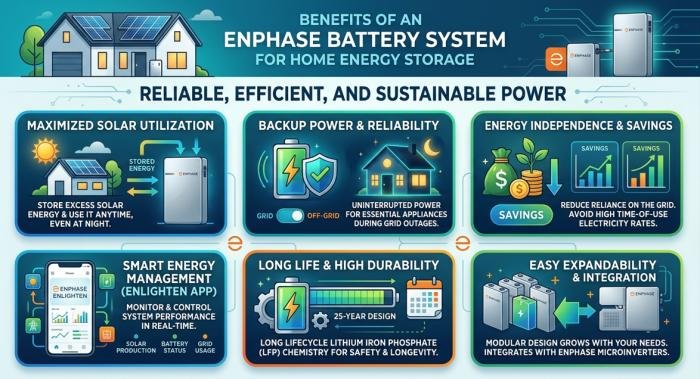
Reliable Backup Power During Outages
One of the main reasons homeowners consider battery storage is the ability to maintain power during a grid interruption. A properly designed Enphase system can supply selected appliances and circuits when utility electricity is unavailable.
This can be especially useful for households that depend on refrigeration, internet connectivity, lighting, communication devices, or essential home equipment. It can also help reduce disruption during storms, maintenance interruptions, and other power failures.
However, backup power has practical limits. A battery cannot supply electricity indefinitely, and a small system may not be able to operate every appliance at once. Homeowners should identify their most important loads and ask an installer to calculate how much power those devices require.
Better Use of Solar Energy
Solar panels typically generate the most electricity during daylight hours, while many households consume substantial electricity in the evening. A battery helps bridge this timing gap.
Instead of relying entirely on the grid after sunset, homeowners can use solar energy stored earlier in the day. This can improve solar self-consumption, particularly where household demand is higher outside normal sunlight hours.
The benefit depends on the balance between solar production and household consumption. A home that uses most of its electricity during the day may have less need for storage than a home with high evening demand.
Potential Electricity Bill Savings
A battery can help reduce electricity costs when stored energy replaces grid electricity that would otherwise be purchased at a higher rate. This can be valuable in areas where electricity prices vary by time of day or where exported solar energy receives limited compensation.
For example, a homeowner may store excess solar electricity in the afternoon and use it in the evening rather than purchasing electricity from the utility. The financial benefit depends on the difference between the cost of imported electricity and the value of exported solar energy.
A battery does not automatically guarantee lower bills. Charging losses, installation costs, battery degradation, tariffs, and financing charges all affect the final result. A realistic financial assessment should compare expected savings over the battery’s useful life with the total installed cost.
Smart Energy Monitoring
Compatible Enphase systems can provide energy monitoring through the Enphase App. Depending on the equipment and software configuration, users can review solar production, battery status, energy consumption, and grid interaction.
This information helps households recognize patterns in their electricity use. For instance, a homeowner may notice that air conditioning or water heating accounts for a large share of evening consumption and adjust usage to preserve battery capacity.
Monitoring also helps users check whether the system is behaving as expected. If energy flows or battery charging patterns seem unusual, the available data can help the installer diagnose the issue.
Flexible System Sizing
Household energy requirements vary widely. A small home may need backup for lighting, a refrigerator, and communication equipment, while a larger property may require support for multiple rooms and higher-power appliances.
Some Enphase battery systems use modular designs that allow storage capacity to be matched to household needs. Depending on the product generation and regional availability, additional compatible battery units may be installed to increase total storage.
Expanding a system still requires a technical assessment. The installer must confirm compatibility, electrical limits, available space, and whether the existing backup equipment can support the proposed configuration.
A Battery Chemistry Designed for Residential Storage
The Enphase IQ Battery models discussed in this article use lithium iron phosphate (LFP) battery chemistry. LFP is used in stationary energy storage because of its thermal stability and suitability for repeated charging and discharging.
Battery safety also depends on the complete system, including electrical protection, installation quality, operating temperature, monitoring, and adherence to manufacturer instructions. Homeowners should follow the installation manual and applicable local electrical and fire-safety requirements.
Understanding Battery Capacity and Power Output
Two specifications matter when choosing an Enphase battery: energy capacity and power output. Although these terms are related, they measure different things.
What Is Battery Capacity?
Battery capacity, measured in kilowatt-hours, indicates how much energy the battery can store and deliver under specified conditions. A battery with greater usable capacity can generally support a given load for longer than a smaller battery.
For example, the IQ Battery 5P has 5 kWh of usable energy. If a household draws an average of 500 watts from the battery, or 0.5 kW, a simple calculation gives:
5 kWh ÷ 0.5 kW = 10 hours.
This is an illustrative estimate, not a guarantee of actual backup duration. Conversion losses, operating limits, changing appliance demand, reserve settings, and the amount of energy available at the start of an outage can shorten the runtime.
What Is Power Output?
Power output, measured in kilowatts (kW) or kilovolt-amperes (kVA), describes how much power the battery can deliver at a particular moment.
A battery might contain enough energy to run appliances for several hours but still be unable to operate several high-power devices simultaneously. Air conditioners, pumps, kettles, and other appliances can draw substantial power, especially when their motors start.
The IQ Battery 5P is specified for up to 3.84 kW of continuous output in single-phase operation. Its supported output can differ by regional configuration, including three-phase applications. Homeowners should check the applicable product data sheet rather than assume that every configuration delivers the same power.
How Much Battery Storage Does a Home Need?
The right capacity depends on the appliances a household wants to operate, how long backup power is required, and whether solar panels can recharge the battery during an outage.
A practical sizing process begins with a list of essential devices and their approximate power requirements. The household should estimate how many hours each device needs to run and calculate the combined energy demand.
For example, a household that needs to operate a refrigerator, several LED lights, a router, and a few charging devices will have different requirements from a household that wants to run air conditioning, electric cooking equipment, and water pumps.
It is also important to distinguish between essential-load backup and whole-home backup. Essential-load systems prioritize selected circuits, while whole-home configurations are designed to support a broader range of household circuits, subject to the system’s power and energy limits.
Enphase Battery for Reliable Home Backup Power
Backup power is most useful when the system is designed around real household priorities. Rather than assuming that every appliance can operate normally during an outage, homeowners should determine which devices need continuous power and which can be switched off temporarily.
Essential Appliances to Prioritize
Common backup priorities include:
- Refrigerators and freezers to protect food.
- LED lighting for safe movement around the home.
- Routers and communication equipment to maintain connectivity.
- Mobile phone chargers and computers for communication and work.
- Selected medical or accessibility equipment, where the system has been professionally assessed for the required reliability.
- Fans or other modest cooling equipment, depending on available power.
Can Solar Panels Recharge the Battery During an Outage?
A properly configured solar-and-battery system may continue producing solar electricity during a grid outage. This depends on the battery model, backup equipment, system configuration, sunlight conditions, and manufacturer-supported operating modes.
When conditions permit, solar generation can supply household loads and recharge the battery. This may extend backup operation beyond the energy initially stored, particularly during sunny periods.
Nevertheless, cloudy weather, rain, shade, and high household demand can reduce available energy. Homeowners should not assume that solar panels will keep the battery fully charged throughout an extended outage.
Managing Battery Reserve Settings
Some compatible Enphase systems allow users to reserve a portion of battery capacity for backup. A higher reserve leaves more stored energy available if the grid fails, while a lower reserve may allow more energy to be used for everyday household consumption.
The ideal setting depends on local outage patterns and financial priorities. A household that experiences frequent interruptions may prefer a larger reserve, whereas a household with a reliable grid and a strong focus on daily self-consumption may choose differently.
Users should confirm the available settings for their system and follow the manufacturer’s instructions.
Installation Requirements and Compatibility
Installing an Enphase battery involves more than mounting a storage unit on a wall. The complete system must be designed to work safely with the home’s solar equipment, electrical panel, utility connection, and intended backup loads.
Before installation, a qualified professional should review the existing inverter technology, electrical service, available mounting space, wiring requirements, environmental conditions, and local approval requirements.
Homeowners who already have solar panels should confirm whether their existing equipment is compatible with the selected battery. Compatibility can vary by battery generation, inverter type, system controller, and country. Some systems may require additional equipment or electrical modifications.
Installation should also account for ventilation and clearances specified by the manufacturer, protection from unsuitable environmental conditions, secure mounting, and access for inspection or service. The battery should not be installed in a location that violates product requirements or local electrical and fire-safety rules.
After installation, the system needs to be commissioned and tested. The installer should verify charging, discharging, monitoring, backup transition, and the operation of the circuits intended to remain powered during an outage.
Enphase Battery Cost and Long-Term Value
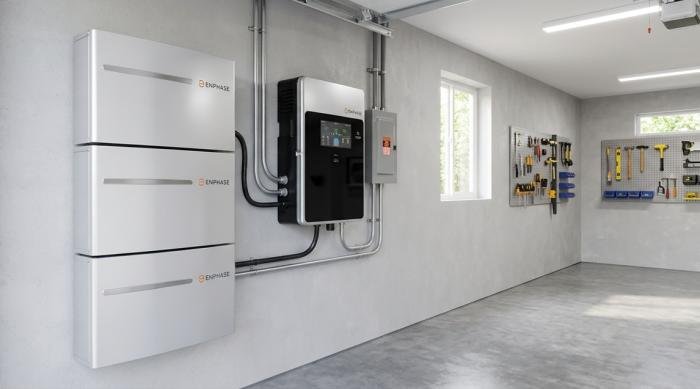
The total cost of an Enphase battery system varies according to the selected model, storage capacity, installation complexity, backup requirements, and local market conditions. Additional equipment, electrical upgrades, permits, and labor can affect the final price.
Rather than comparing battery prices alone, homeowners should request a complete installed quote. The quote should identify the battery model, usable capacity, continuous power output, backup equipment, monitoring components, warranty coverage, and any work required on the existing electrical system.
Long-term value depends on how often the battery is used and how much money it saves. A home with high evening electricity consumption and low compensation for exported solar energy may benefit more than a home that uses most of its solar power during daylight hours.
To estimate potential savings, compare expected annual bill reductions with the total installed cost. Consider battery degradation, charging losses, possible maintenance expenses, financing charges, and the value of having backup power. Backup convenience can be important, but it should be evaluated separately from direct financial savings.
Maintenance and Battery Lifespan
Enphase battery systems are designed for residential use, but they still require appropriate installation, monitoring, and care. Homeowners should follow the maintenance schedule and operating instructions supplied with their specific product.
Keep the installation area within the environmental limits stated by the manufacturer. Check the monitoring app periodically for unexpected alerts, unusual charging behavior, or changes in system performance. Any electrical fault, damaged enclosure, or warning that requires professional attention should be handled by a qualified service provider.
Battery capacity can decline over time as the battery undergoes use and aging. The rate depends on operating conditions, charging patterns, temperature, and the specific product. Warranty terms may define a coverage period and other conditions, but homeowners should review the applicable document rather than assume every model has identical coverage.
A well-planned installation, sensible energy settings, and prompt attention to faults can help the system perform as intended over its service life.
Is an Enphase Battery Right for Your Home?
An Enphase battery may be a suitable choice for homeowners who already use solar energy or plan to install a compatible solar system and want to store electricity for later use. It can be particularly useful when evening electricity demand is high, outages are disruptive, or the household values greater control over energy consumption.
However, not every home needs battery storage. If grid electricity is inexpensive and reliable, solar exports are well compensated, or the household uses most of its electricity during the day, the financial case may be less attractive.
The best approach is to compare the household’s energy profile with the battery’s usable capacity and output limits. Request a system design that explains which appliances can operate during an outage, how long the stored energy may last, and what happens when solar generation is limited.
A professional assessment should also confirm compatibility, installation requirements, local support, and the exact warranty. These checks help ensure that the selected battery meets practical household needs rather than simply offering an appealing specification sheet.
Conclusion
The Enphase battery can be a practical investment for homeowners who want dependable backup power, improved solar energy utilization, and greater flexibility in managing household electricity. Selecting the right model requires careful consideration of battery capacity, power output, installation requirements, compatibility, and total cost.
Homeowners should also evaluate their daily energy consumption and decide which appliances need backup during an outage. With professional installation, suitable system settings, and regular performance monitoring, an Enphase battery system can support a more reliable and efficient home energy setup. Comparing available models and reviewing local warranty and service options will help ensure the system meets your household’s needs.
FAQS
Q: What is an Enphase battery used for?
Ans: An Enphase battery stores electricity for later use in a home. When paired with compatible solar panels and equipment, it can store excess solar energy, reduce reliance on grid electricity, and provide backup power during outages when the system is configured for backup operation.
Q: How long can an Enphase battery power a home?
Ans: Backup duration depends on usable battery capacity, appliance consumption, conversion losses, and available solar generation. A battery may run essential appliances for several hours, but high-power devices can shorten runtime considerably. A qualified installer can estimate the expected duration based on your household’s energy requirements.
Q: Can an Enphase battery work without solar panels?
Ans: Some configurations may support charging from the grid, depending on the model, system design, and local regulations. However, the ability to charge from the grid and provide backup varies by installation. Confirm these capabilities with an authorized installer before purchasing.
Q: Does an Enphase battery provide whole-home backup?
Ans: It can support whole-home backup in suitable configurations, but this is not guaranteed for every installation. Battery power output, total storage capacity, electrical equipment, and household demand determine what can be supported. Some systems are designed to power only selected essential circuits.
Q: How much energy can an Enphase IQ Battery 5P store?
Ans: The Enphase IQ Battery 5P has 5 kWh of usable energy capacity. Its continuous power output in single-phase operation is specified at up to 3.84 kW. These figures describe different capabilities: capacity affects how long energy is available, while power output affects how much equipment can run simultaneously.



Pingback: Vacuum Circuit Breaker: Types, Working Principle and Applications
Pingback: Loom Solar: Affordable and Efficient Solar Energy Solutions for Homes
Pingback: Structurespy com: Website Features, Services, and User-Friendly Guide