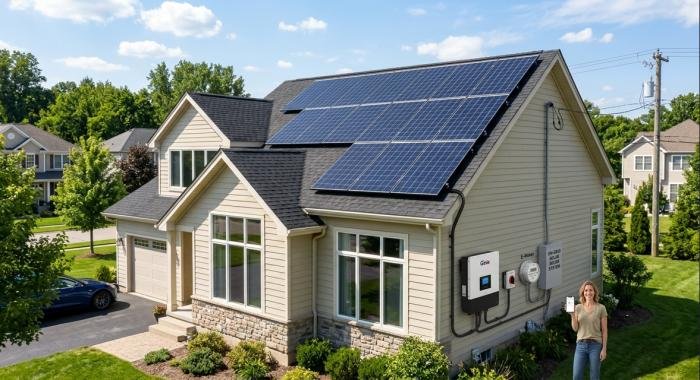

An on grid solar system is a smart and cost-effective way to generate electricity using sunlight while staying connected to the main utility grid. It allows homeowners and businesses to produce their own solar power, reduce dependence on conventional electricity, and lower monthly energy bills.
As electricity costs continue to rise and renewable energy becomes more popular, on grid solar systems are gaining attention as a practical solution for cleaner and more efficient energy use.
What Is an On Grid Solar System?
An on grid solar system, also known as a grid-tied solar system, is a photovoltaic installation connected to the public electricity network. Solar panels capture sunlight and convert it into direct current (DC) electricity. A solar inverter then converts DC electricity into alternating current (AC), which is used by household and commercial appliances.
The system works together with the utility grid. During sunny hours, solar electricity powers connected appliances. If the panels produce more electricity than the property needs, the extra energy can be exported to the grid under an approved net metering Arrangement. At night or during periods of low sunlight, the property receives electricity from the utility provider. The following table shows the main components and their functions:
| Component | Main Function |
| Solar panels | Convert sunlight into DC electricity |
| Solar inverter | Convert DC electricity into AC power |
| Net meter | Measure imported and exported electricity |
| Mounting structure | Hold solar panels securely |
| Electrical cables | Transfer electricity safely |
| Protection devices | Protect the system from electrical faults |
How Does an On Grid Solar System Work?
The working process of an on grid solar system is simple. Different components operate together to generate electricity, supply appliances, and manage the connection with the utility grid.
Solar Panels Generate Electricity
Solar panels are installed on rooftops or open spaces where they receive sufficient sunlight. Their photovoltaic cells convert solar energy into DC electricity. The amount of electricity generated depends on panel capacity, sunlight availability, temperature, shading, and installation direction.
The Inverter Converts Electricity
The solar inverter converts DC electricity from the panels into AC electricity. It also synchronizes the generated power with the utility grid so that the electricity can safely supply compatible appliances.
Read More: WPS Office MOD APK: Features, Risks, and Safer Options
Solar Power Runs Electrical Appliances
The generated electricity is first used to meet the property’s electricity demand. Lights, fans, refrigerators, computers, air conditioners, and other appliances can operate using solar electricity when sufficient power is available.
Excess Electricity Goes to the Grid
When solar production exceeds the property’s consumption, surplus electricity can flow into the utility network. Depending on local regulations, users may receive credits or financial adjustments through net metering.
The Grid Supplies Additional Power
When solar panels cannot generate enough electricity, the utility grid supplies the remaining demand. This usually happens at night, during cloudy weather, or when electricity consumption is higher than solar production.
Main Components of an On Grid Solar System
A properly designed on grid solar system requires several important components to operate safely and efficiently.
Solar Panels: Solar panels capture sunlight and generate DC electricity. Monocrystalline panels are commonly selected because they offer good efficiency and power output.
Grid-Tied Inverter: The inverter converts DC electricity into AC power and synchronizes the system with the utility grid. String inverters and microinverters are common options.
Net Meter: A suitable net meter records electricity imported from and exported to the utility grid. It supports the applicable billing arrangement.
Mounting Structure: Mounting structures hold the panels securely. Aluminum and galvanized steel are common materials used for solar installations.
Cables and Protection Devices: DC and AC cables transfer electricity between system components. Circuit breakers, isolators, surge protection, and proper earthing help protect the installation.
Benefits of an On Grid Solar System
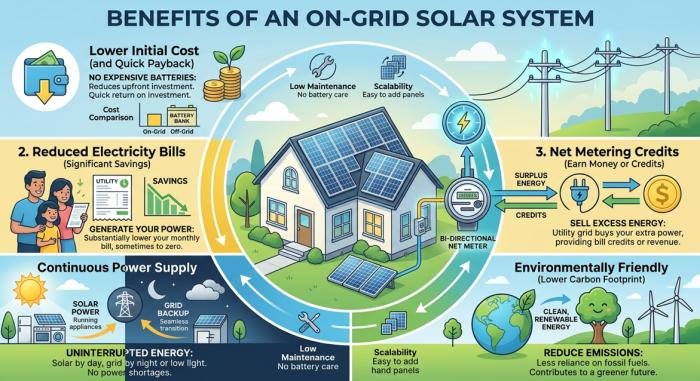
An on grid solar system provides several financial and environmental advantages for residential and commercial electricity users.
Reduced Electricity Bills
The biggest benefit is the potential to reduce monthly electricity expenses. Solar panels generate electricity during daylight hours, reducing the amount of power purchased from the utility company. Properties with higher daytime electricity consumption can often make better use of the generated solar energy.
Lower Initial Investment
Since a standard on grid solar system generally operates without batteries, its initial investment can be lower than that of an off grid or battery-based system. Users do not need to purchase a large battery bank or deal with regular battery replacement.
Better Use of Renewable Energy
The system allows properties to use solar electricity directly and export excess generation when permitted. This helps make productive use of available sunlight without requiring extensive energy storage.
Environmentally Friendly Power
Solar energy generates electricity without directly producing greenhouse gas emissions during operation. Using solar electricity can reduce dependence on conventional power generation and contribute to cleaner energy consumption.
Low Maintenance Requirements
An on grid solar system has relatively few moving parts. Regular panel cleaning, inverter monitoring, cable inspection, and professional maintenance can help keep the installation operating efficiently.
Suitable for Different Properties
The system can be designed for houses, offices, factories, shopping centers, schools, and other commercial properties. Its capacity can be adjusted according to electricity consumption and available installation space.
On Grid Solar System Cost
The cost of an on grid solar system depends on its capacity, panel quality, inverter brand, mounting structure, installation expenses, and local utility requirements.
A small residential installation generally costs less than a large commercial project. However, choosing equipment only because it has a low price may result in poor performance or additional maintenance expenses. The following figures are illustrative international budget estimates, not verified local quotations:
| System Capacity | Suitable Application | Estimated Cost (USD) |
| 1 kW | Small household | 600–1,000 |
| 2 kW | Small residential property | 1,000–1,600 |
| 3 kW | Average household | 1,400–2,300 |
| 5 kW | Medium-sized home | 2,000–3,500 |
| 10 kW | Large home or small business | 3,800–6,500 |
| 20 kW | Commercial property | 7,000–12,000 |
Energy Savings from an On Grid Solar System
Energy savings depend on how much electricity the solar panels generate and how much of that electricity the property consumes directly. For example, a 5 kW solar installation receiving approximately four equivalent peak-sun hours per day may generate around 20 kWh daily before accounting for system losses. Estimated monthly production:
5 kW × 4 hours × 30 days = 600 kWh.
Actual production will vary depending on weather, shading, panel direction, temperature, and inverter efficiency.
If the property directly consumes 450 kWh of solar electricity and exports the remaining 150 kWh, the total financial benefit will depend on the local electricity tariff and export compensation rate. Properties that operate during daylight hours can often benefit more because they consume solar electricity when it is generated.
On Grid Solar System for Homes and Businesses
An on grid solar system is suitable for many residential properties with a reliable utility connection. Homeowners can use solar power for lighting, fans, refrigerators, televisions, computers, and other everyday appliances.
Businesses can also benefit from larger installations. Factories, offices, warehouses, shopping centers, and educational institutions often have substantial daytime electricity requirements. Rooftop solar panels can help reduce their electricity expenses.
Before installation, homeowners and business owners should review their electricity bills, available rooftop space, daily consumption patterns, and utility requirements. A properly sized system can provide better financial value than an unnecessarily large installation.
On Grid vs Off Grid vs Hybrid Solar System
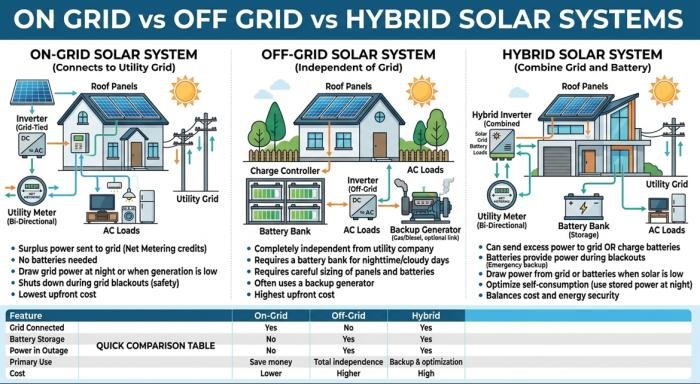
Different solar configurations serve different electricity requirements.
| Feature | On Grid | Off Grid | Hybrid |
| Grid connection | Yes | No | Yes |
| Battery requirement | Usually no | Usually yes | Optional or included |
| Initial cost | Generally lower | Generally higher | Generally higher |
| Grid electricity | Available | Not available | Available |
| Backup during outages | Not in standard systems | Yes, if designed properly | Yes, if configured |
| Best application | Grid-connected properties | Remote locations | Properties needing backup |
Is an On Grid Solar System Suitable for Bangladesh?
Bangladesh receives considerable sunlight throughout the year, making solar electricity a practical option for many homes and businesses. An on grid solar system can help reduce electricity purchases by generating power during daylight hours. Residential rooftops, factories, offices, and commercial buildings may provide suitable installation spaces. However, consumers should check current net metering policies, utility approval requirements, approved equipment standards, and electricity export compensation before installing a system.
Weather conditions, humidity, rainfall, and dust should also be considered during system design. A qualified solar installer can assess the roof, electrical connection, and expected energy generation before recommending the appropriate capacity.
How to Choose the Right On Grid Solar System
Selecting the correct solar system requires careful planning.
Review Electricity Bills: Check electricity consumption over the previous 6–12 months to estimate the required solar capacity.
Choose Quality Panels: Compare panel efficiency, rated output, product warranty, and manufacturer reputation.
Select a Suitable Inverter: Choose an inverter that matches the panel capacity and local grid requirements.
Check Roof Conditions: Make sure the installation area has sufficient space, good sunlight exposure, and adequate structural strength.
Compare Quotations: Request quotations from multiple installers and compare equipment specifications, installation charges, warranties, and safety arrangements.
Check Net Metering Rules: Confirm whether the property is eligible to export excess electricity and receive applicable credits.
Installation and Maintenance
The installation process generally starts with a site inspection and electricity consumption assessment. The installer then prepares a system design, selects suitable equipment, and obtains necessary utility approvals.
After approval, the mounting structure and solar panels are installed. The inverter, cables, protection devices, and electrical connections are then completed. Finally, the system is tested and commissioned according to applicable safety and grid requirements.
Regular maintenance helps maintain performance. Clean the panels when necessary, monitor electricity generation, inspect mounting structures, and arrange professional checks of electrical connections. Any electrical repair should be handled by a qualified technician.
Conclusion
An on grid solar system is a practical investment for anyone looking to reduce electricity expenses and use renewable energy without completely disconnecting from the utility grid. With proper system design, quality components, and professional installation, it can provide long-term savings and reliable solar power during sunny hours.
Before installing a system, consider your electricity consumption, available rooftop space, budget, and local grid connection requirements to choose a solution that meets your energy needs.
FAQs
Q1. What is an on grid solar system?
Ans: An on grid solar system is a solar installation connected to the public electricity network. It generates electricity from sunlight and uses the utility grid when solar production is insufficient.
Q2. Does an on grid solar system work at night?
Ans: Solar panels do not generate electricity at night. The property receives electricity from the utility grid when solar production is unavailable.
Q3. Can an on grid solar system work during a power outage?
Ans: A standard grid-tied inverter shuts down during a grid outage. An approved backup arrangement with suitable battery storage is needed to supply electricity during interruptions.
Q4. How much does an on grid solar system cost?
Ans: The price depends on system capacity, equipment quality, inverter brand, installation expenses, and local utility requirements. A professional quotation provides the most accurate estimate.
Q5. How much electricity can a 5 kW solar system generate?
Ans: A 5 kW system may generate approximately 15–25 kWh per day under favorable conditions. Actual production depends on sunlight, weather, shading, and system efficiency.
Q6. Does an on grid solar system need batteries?
Ans: No. A standard on grid solar system generally operates without batteries because the utility grid supplies additional electricity when solar production is insufficient.