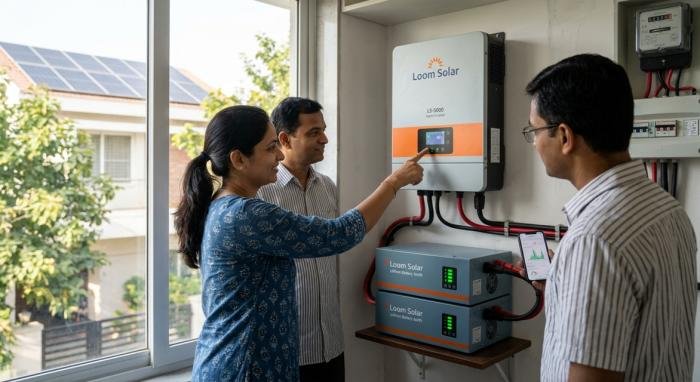

Solar energy is becoming a popular choice for homeowners who want to reduce electricity expenses and switch to cleaner energy sources. With increasing electricity consumption and growing interest in renewable power, installing a residential solar system can be a practical long-term investment.
Loom Solar offers a range of solar panels, inverters, and lithium batteries designed to support different household energy requirements. From generating electricity through rooftop panels to storing excess power for later use, its solar solutions provide homeowners with flexible options for managing everyday electricity needs.
| Solar component | Main function | Residential benefit |
| Loom Solar panels | Convert sunlight into electricity | Generate renewable household power |
| Solar inverter | Converts and manages electrical power | Makes solar electricity usable for household appliances |
| Lithium battery | Stores electrical energy | Provides backup power when required |
| Mounting structure | Holds panels in position | Supports safe and suitable rooftop installation |
| Solar protection equipment | Helps protect the system electrically | Improves operational safety and reliability |
| Monitoring system | Tracks system performance where supported | Helps homeowners monitor energy production |
What Is Loom Solar?
Loom Solar is an Indian solar energy brand founded in 2018 and headquartered in Faridabad, Haryana. The company serves residential and commercial customers with solar-related products and energy solutions. Its business focuses on solar panels, inverters, lithium batteries, and related energy technologies. The brand aims to make modern solar equipment more accessible to customers looking for alternatives to conventional electricity.
One of the important aspects of Loom Solar is its range of products covering different stages of household solar power. Solar panels generate electricity, inverters manage power conversion, and batteries store energy for later use. Instead of treating these components as unrelated purchases, homeowners can consider how they work together to meet their energy requirements.
Read More: Enphase Battery: Smart Home Energy Storage for Reliable Backup Power
The company offers products under different product families. SHARK is associated with its solar PV modules, Fusion represents its solar inverter range, and CAML covers lithium battery products. These categories serve different purposes and allow customers to select equipment according to the design of their solar installation.
For homeowners, brand selection should involve more than comparing product names or promotional claims. Product specifications, applicable certifications, warranty conditions, installation quality, compatibility, and after-sales support should all be considered. A suitable solar system is one that meets the property’s actual energy requirements rather than simply having the highest advertised capacity.
Why Are More Homeowners Choosing Solar Energy?
Solar energy has become an attractive option for households because it offers a different way to generate electricity. Traditional electricity systems depend on power supplied through the utility grid, while rooftop solar installations allow homeowners to produce some or most of their electricity at their own properties.
The amount of electricity a solar installation generates depends on several factors, including panel capacity, sunlight availability, roof direction, shading, temperature, and system efficiency. A well-planned installation can help reduce the amount of electricity a household needs to purchase from the grid.
Another reason homeowners consider solar is the possibility of long-term financial savings. Although installing a solar system requires an initial investment, the electricity it generates can reduce future utility expenses. The actual savings depend on system cost, local electricity tariffs, applicable export or net-metering arrangements, maintenance expenses, and daily household consumption.
Solar power can also support a more environmentally responsible lifestyle. Electricity generated from sunlight does not require fuel combustion at the point of generation. By replacing part of the electricity supplied by conventional generation sources, solar installations can contribute to reducing household-related emissions.
For households experiencing power interruptions, a battery-supported solar arrangement may provide additional convenience. However, not every rooftop solar installation automatically provides backup during a grid failure. The inverter configuration, battery availability, and electrical design determine whether backup power is possible.
Loom Solar Panels for Residential Rooftops
Solar panels are the foundation of any rooftop solar energy system. They contain photovoltaic cells that convert sunlight into direct-current electricity. The electricity is then processed by an inverter or charging system depending on the installation design.
Loom Solar offers SHARK PV modules designed for residential and other solar applications. Its product range includes different panel technologies and capacities. The right selection depends on the available installation space, required system capacity, product specifications, and project budget.
High-Efficiency Solar Panel Technology
Solar panel efficiency describes how effectively a module converts the sunlight falling on its surface into electricity. Higher-efficiency panels can generate more electricity from a given roof area when compared under similar conditions.
This feature can be especially useful for homes with limited rooftop space. Instead of installing a large number of lower-capacity panels, homeowners may be able to meet their energy requirements with fewer high-capacity modules, depending on the available models and installation conditions.
However, efficiency should not be the only purchasing factor. Panel dimensions, temperature performance, mechanical strength, product warranty, degradation rate, and electrical compatibility also deserve attention.
Making Better Use of Rooftop Space
The amount of usable roof space determines how many panels can be installed. Homeowners should account for water tanks, staircases, ventilation equipment, nearby buildings, trees, and other objects that may create shade.
A professional site assessment can help determine the most appropriate panel arrangement. It should also consider access pathways, roof strength, drainage, and maintenance requirements. Proper positioning allows panels to receive sufficient sunlight while reducing unnecessary installation problems.
Consistent Electricity Generation
Solar panels produce electricity during daylight hours, with output changing throughout the day. Cloud cover, rain, dust, seasonal sunlight, and high temperatures can affect actual generation.
Regular cleaning and inspection can help maintain panel performance. In areas with frequent dust or pollution, dirt accumulation may reduce the amount of sunlight reaching the photovoltaic cells. Cleaning should follow the manufacturer’s recommendations and appropriate safety procedures.
Loom Solar Inverters and Their Role in Home Energy
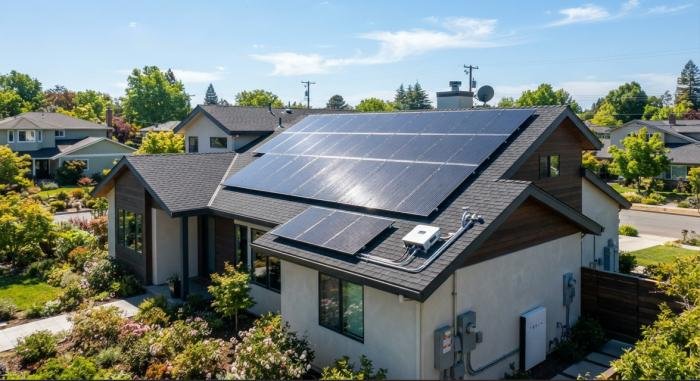
Solar panels generate direct-current electricity, while most household appliances use alternating-current electricity. A solar inverter performs the conversion needed to make solar-generated electricity suitable for the household electrical system.
Loom Solar offers Fusion solar inverters in different configurations. Choosing the right inverter is important because it affects how the system interacts with the electricity grid, household appliances, and battery storage.
On-Grid Solar Inverters
An on-grid inverter connects a solar installation to the electricity grid. During daylight hours, the system can supply solar-generated electricity to household loads. Depending on the system configuration and local utility rules, excess electricity may be exported to the grid.
This arrangement can be suitable for homeowners who have access to a reliable electricity connection and primarily want to reduce their electricity purchases.
One important limitation is that standard grid-connected solar systems generally shut down during a grid outage for safety reasons. This prevents electricity from being sent into utility lines while workers may be repairing them. Therefore, homeowners who require backup during outages should consider a suitable hybrid system or another approved backup arrangement.
Hybrid Solar Inverters
Hybrid inverters can coordinate electricity from solar panels, batteries, and the utility grid, depending on the model and system configuration. They are useful for households that want both solar generation and battery storage.
A hybrid system may store surplus daytime electricity for use during the evening or an outage. Its actual backup capability depends on battery capacity, inverter specifications, supported backup circuits, and the household’s electrical load.
Before purchasing a hybrid inverter, homeowners should confirm which appliances can receive backup power, whether the inverter supports the intended battery, and whether the system can handle the required starting and operating loads.
Selecting the Right Inverter Capacity
Inverter capacity should be matched with the solar panel arrangement and household electricity requirements. An undersized inverter may limit system output or struggle with the intended load, while an unsuitable oversized model may increase installation costs without providing meaningful benefits.
A qualified installer should review the inverter’s rated output, maximum PV input, voltage range, phase requirements, battery compatibility, and protection features before recommending a model.
Loom Solar Lithium Batteries for Reliable Backup
Battery storage is an important consideration for households that want to use solar energy beyond daylight hours. Solar panels generate electricity when sunlight is available, but household electricity consumption continues throughout the evening and night.
Loom Solar’s CAML product family includes lithium battery solutions for energy storage applications. These batteries can be considered for suitable solar and inverter configurations where stored electricity is required.
How Lithium Battery Storage Works
During periods of solar generation, a compatible charging system can direct surplus electricity into a battery. The stored energy can then be used when solar production decreases or when backup power is needed.
This arrangement helps households make better use of the electricity generated by their solar panels. It can also reduce dependence on the grid during selected periods, depending on the battery capacity and household consumption.
Choosing Suitable Battery Capacity
Battery capacity is generally expressed in kilowatt-hours (kWh), while inverter output is commonly measured in kilowatts (kW). These measurements describe different things.
Kilowatt-hours indicate how much energy a battery can store, whereas kilowatts describe the rate at which electricity can be delivered. A battery with a larger energy capacity can generally provide power for a longer period, assuming the connected load remains the same.
For example, a household that wants to operate lights, fans, routers, and selected essential appliances during an outage will have different storage requirements from a home that wants to operate air conditioners, pumps, and several high-power appliances.
The battery should be selected according to the expected backup duration, appliance consumption, allowable depth of discharge, inverter compatibility, and available budget.
Battery Safety and Maintenance
Battery safety should be treated as a priority. Homeowners should use compatible charging equipment, follow installation instructions, and ensure suitable ventilation and environmental conditions according to the manufacturer’s specifications.
A lithium battery with an appropriate battery management system can monitor operating conditions and provide protective functions. Nevertheless, the exact features depend on the model. Buyers should review the technical documentation, warranty, operating temperature range, and recommended installation conditions before purchasing.
How Loom Solar Can Help Reduce Household Electricity Expenses
One of the main reasons homeowners consider solar power is the potential to reduce monthly electricity costs. A rooftop solar installation can generate electricity for household consumption, reducing the quantity that must be purchased from the utility.
The financial benefit depends on how much electricity the solar system generates and how much of that electricity the household uses. A system that produces electricity when household demand is high may offer greater direct consumption benefits than one that regularly generates more electricity than the household can use.
For example, a family that operates washing machines, water pumps, refrigerators, and other appliances during daylight hours may be able to use a larger share of its solar generation directly.
Households that are mostly occupied during the evening may benefit from a battery-supported arrangement, although adding batteries increases the initial investment. The financial value of storage should therefore be assessed carefully rather than assumed.
Understanding Solar Payback Period
The payback period refers to the estimated time required for the financial savings from a solar installation to recover its initial cost.
A simple calculation is:
Payback period = Initial installation cost ÷ Estimated annual net savings
For instance, if a system costs ₹2,00,000 and produces estimated net annual savings of ₹40,000, the simple payback period would be five years.
This is only an illustrative calculation. Actual results may differ because electricity prices, system generation, maintenance costs, financing expenses, and applicable utility arrangements can change.
Homeowners should request a written quotation with a realistic generation estimate and a clear explanation of the assumptions used to calculate savings.
Types of Residential Solar Systems to Consider
Different homes have different electricity requirements. A suitable system depends on grid availability, backup expectations, roof conditions, and the household’s budget.
Grid-Connected Solar Systems
Grid-connected systems are designed to operate alongside the utility electricity supply. They are generally suitable for properties with a stable grid connection and a goal of reducing electricity bills.
These systems can provide strong financial value when local net-metering or other approved export arrangements are available. Homeowners should check the current rules with their electricity distribution company before installation.
Off-Grid Solar Systems
Off-grid systems operate independently of the utility grid and generally require battery storage. They can be suitable for remote properties where grid electricity is unavailable or unreliable.
System design must account for the household’s complete energy requirements, expected backup duration, seasonal sunlight variation, and battery replacement costs.
Hybrid Solar Systems
Hybrid systems combine solar generation with battery storage and a grid connection where supported. They provide greater flexibility because the system can use solar power, store surplus electricity, and draw from the grid when needed.
This arrangement may be attractive to households that experience frequent outages and want to reduce their dependence on conventional electricity.
Important Factors Before Buying Loom Solar Products
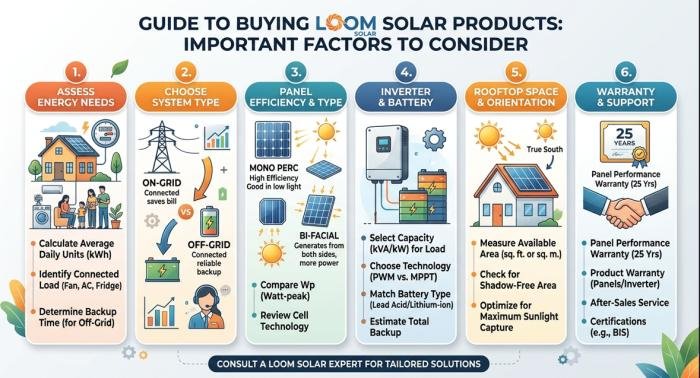
Buying solar equipment is a long-term decision. Homeowners should compare products based on technical performance, system compatibility, installation quality, and ownership costs.
1. Review Your Monthly Electricity Consumption
Start by checking electricity bills from the previous six to twelve months. The information can help identify average monthly consumption and seasonal changes.
A household using 200 units per month will generally require a different solar capacity from one using 700 units. However, the final recommendation should also consider daytime usage and future electricity requirements.
2. Check Available Roof Space
Roof space determines the potential number of panels. The installer should measure usable space and identify shaded areas before preparing a system design.
A roof assessment should also consider the structural condition of the building and whether it can safely support the mounting structure and solar modules.
3. Compare Product Specifications
Do not select panels, inverters, or batteries based only on price. Compare rated capacity, efficiency, warranty, electrical specifications, certifications, operating conditions, and compatibility.
A lower-priced product may not necessarily provide the best long-term value if it has unsuitable specifications or limited support.
4. Understand Warranty Conditions
Solar equipment can operate for many years, so warranty coverage matters. Panel product warranties, performance warranties, inverter warranties, and battery warranties are different.
Check the exact warranty duration, coverage limitations, claim process, and conditions for maintaining eligibility. Always obtain warranty documents from the seller.
5. Choose Qualified Installation Support
Even good-quality equipment can perform poorly when installed incorrectly. Incorrect wiring, poor mounting, inadequate grounding, or unsuitable electrical protection can affect safety and performance.
Work with qualified solar professionals who can provide proper system design, installation documentation, commissioning, and after-sales support.
6. Consider Future Electricity Needs
Household electricity consumption may increase when families add air conditioners, electric vehicles, water heaters, or other appliances.
Planning for possible future demand can help avoid unnecessary system changes. However, the system should not be oversized without a practical reason.
Loom Solar Installation Process for Homes
A successful solar project begins with proper planning. Homeowners should understand the major installation stages before committing to a purchase.
Step 1: Initial Energy Assessment
The process begins with reviewing electricity bills, household consumption patterns, and backup requirements. This information helps determine the approximate system capacity.
Step 2: Rooftop Inspection
The installation team evaluates the roof, available sunlight, shading, structural conditions, and possible panel locations. The inspection also helps identify any special mounting requirements.
Step 3: System Design and Quotation
The installer prepares a proposed system design containing the panel capacity, inverter type, battery requirements if applicable, mounting arrangement, protection equipment, and estimated project cost.
Step 4: Product Selection
Homeowners review the proposed equipment and confirm whether the selected products meet their requirements. Compatibility between panels, inverters, and batteries should be checked before purchase.
Step 5: Installation and Electrical Connections
Solar panels are mounted securely, and the electrical components are connected according to the approved design. Appropriate wiring, grounding, isolation, and protection equipment are important for safe operation.
Step 6: Testing and Commissioning
After installation, the system should be tested to verify electrical connections, inverter operation, safety functions, and expected performance. The homeowner should receive the relevant documents and operating instructions.
Step 7: Monitoring and Maintenance
Once the system becomes operational, homeowners should monitor energy production and arrange periodic inspections. Any unusual performance changes, warning messages, or electrical issues should be checked by a qualified technician.
Maintenance Tips for Better Solar System Performance
Solar systems generally require less routine maintenance than many conventional electricity-generating technologies. However, regular attention can help preserve performance and identify potential problems.
Keep solar panels clean: Dust, leaves, bird droppings, and other debris can reduce the sunlight reaching the panel surface. Follow the manufacturer’s cleaning instructions and avoid unsafe rooftop work.
Inspect electrical connections: Periodic professional inspections can identify loose connections, damaged cables, corrosion, or other issues before they become more serious.
Monitor inverter performance: Review available inverter displays or monitoring applications to identify unexpected reductions in electricity generation.
Maintain battery conditions: Battery systems should be operated within the recommended temperature and charging limits. Avoid unauthorized changes to settings.
Check mounting structures: Panels should remain securely fixed. Inspect the mounting structure for signs of corrosion, movement, or damage, particularly after severe weather.
Keep installation records: Store invoices, warranties, system diagrams, product manuals, and maintenance reports. These documents can be useful when requesting service or making warranty claims.
Environmental Benefits of Choosing Solar Energy
Solar energy is a renewable electricity source because it uses sunlight, which is naturally replenished. Residential solar systems can help reduce dependence on electricity generated from fossil fuels.
A rooftop installation generates electricity without directly burning fuel during operation. This can help reduce operational greenhouse gas emissions when solar electricity replaces electricity from more carbon-intensive sources.
Solar installations can also reduce pressure on the conventional electricity supply during periods of strong daytime generation. This is particularly useful in areas where electricity demand increases during hot weather.
However, solar equipment also has an environmental footprint. Manufacturing panels, producing batteries, transporting products, and disposing of old equipment require resources. Responsible recycling and proper end-of-life management are therefore important parts of the solar industry’s long-term development.
Homeowners can contribute by selecting durable products, maintaining equipment properly, and using authorized recycling or disposal channels when components reach the end of their useful life.
Is Loom Solar a Suitable Choice for Your Home?
Loom Solar may be worth considering for homeowners who want to compare solar panels, inverters, and lithium battery products from an established Indian solar brand. Its product categories cover several important parts of a residential solar installation.
The most suitable option depends on the household’s electricity consumption, location, roof condition, budget, and backup requirements. A home that primarily wants to reduce daytime electricity bills may need a different configuration from a property that experiences frequent power interruptions.
Before making a decision, homeowners should compare the available Loom Solar models with other suitable products in the market. Reviewing written specifications, warranty terms, installation arrangements, and customer support can help prevent unexpected expenses.
It is also important to understand that solar savings are not identical for every property. Two homes with similar panel capacities may generate different amounts of electricity because of differences in sunlight, shading, orientation, and weather conditions.
A professional assessment and realistic financial estimate are therefore more valuable than choosing a system based only on advertising claims or a suggested capacity.
Conclusion
Choosing the right solar system can make a meaningful difference in household energy management and long-term electricity expenses. Loom Solar provides various solar products, including SHARK solar panels, Fusion inverters, and CAML lithium batteries, to meet different residential energy needs. Before making a purchase, homeowners should compare product specifications, installation costs, warranty coverage, and electricity requirements. With proper planning, quality equipment, and professional Installation, Loom Solar can be a worthwhile option for households looking to adopt renewable energy and enjoy more efficient electricity management.
FAQs
Q1. What is Loom Solar?
Ans: Loom Solar is an Indian solar energy brand founded in 2018 and headquartered in Faridabad, Haryana. It offers solar panels, inverters, lithium batteries, and related energy products for residential and commercial applications.
Q2. Are Loom Solar panels suitable for residential rooftops?
Ans: Yes. Loom Solar offers SHARK PV modules for residential and other solar applications. The appropriate panel model depends on roof space, electricity requirements, panel specifications, and installation conditions.
Q3. Can Loom Solar help reduce monthly electricity bills?
Ans: A properly designed Loom Solar installation can help reduce electricity purchases by generating power from sunlight. Actual savings depend on solar capacity, household consumption, local electricity tariffs, system cost, and applicable grid-export arrangements.
Q4. Does Loom Solar offer lithium batteries for home backup?
Ans: Loom Solar offers CAML lithium battery products for energy storage applications. Homeowners should check battery capacity, inverter compatibility, backup requirements, and warranty conditions before selecting a model.
Q5. What is the difference between an on-grid and a hybrid solar system?
Ans: An on-grid system works with the utility electricity network and generally does not provide backup during grid outages. A hybrid system can combine solar generation, grid electricity, and compatible battery storage to provide additional energy flexibility and backup.
Q6. How do I choose the right Loom Solar system capacity?
Ans: Review your electricity bills, average daily consumption, daytime appliance usage, rooftop space, and backup requirements. A qualified installer can use this information to recommend an appropriate system capacity.
Q7. Do Loom Solar products require regular maintenance?
Ans: Solar systems generally require limited routine maintenance. Keeping panels clean, checking inverter performance, inspecting electrical connections, and maintaining batteries according to manufacturer instructions can help support reliable operation.