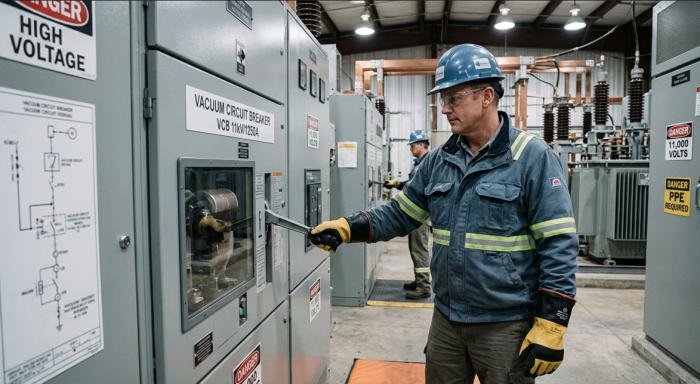

A vacuum circuit breaker is an important electrical switching device used to protect electrical systems from faults, overloads, and short circuits. It plays a significant role in modern power distribution networks because of its reliable operation, fast arc extinction, and low maintenance requirements. A vacuum circuit breaker interrupts the flow of electrical current by separating contacts inside a sealed vacuum chamber. When the contacts separate, an electrical arc forms briefly, but the vacuum environment helps extinguish it quickly.
Vacuum circuit breakers are widely used in medium-voltage electrical installations, industrial facilities, commercial buildings, power plants, and utility substations. Their compact design, long service life, and dependable performance make them a popular choice for protecting transformers, motors, generators, and distribution equipment. Compared with several traditional switching technologies, they can provide efficient fault interruption without requiring oil or a gas-based arc-quenching medium.
Understanding how a vacuum circuit breaker works helps electrical engineers, technicians, students, and facility managers select suitable protection equipment for different applications. Its performance depends on factors such as rated voltage, current capacity, breaking capacity, contact design, operating mechanism, and the characteristics of the electrical network. This article explains the types, working principle, components, applications, advantages, limitations, and maintenance requirements of a vacuum circuit breaker.
What Is a Vacuum Circuit Breaker?
A vacuum circuit breaker (VCB) is an electrical protection and switching device that interrupts current by separating electrical contacts within a sealed vacuum interrupter. The vacuum interrupter contains two main contacts: one stationary and one moving. These contacts remain closed during normal operation, allowing current to flow through the electrical circuit.
When a fault occurs or a switching operation is required, the circuit breaker’s operating mechanism separates the contacts. The separation produces an arc caused by metal vapor released from the contact surfaces. Because the interrupter contains a high vacuum, the metal vapor and charged particles disperse and condense rapidly, allowing the arc to extinguish when the alternating current passes through zero.
Read More: Enphase Battery: Smart Home Energy Storage for Reliable Backup Power
After the arc disappears, the vacuum between the contacts recovers its dielectric strength quickly. This prevents the current from restarting across the contact gap, provided the interrupter is operating within its rated electrical limits.
A vacuum circuit breaker generally operates in medium-voltage systems, commonly around 3.3 kV to 36 kV, although the available ratings depend on the equipment design and applicable standards. Special designs may serve other voltage ranges.
The device can operate automatically through protective relays or manually through a control system. Protective relays monitor electrical conditions and issue a trip command when they detect a fault. The circuit breaker then disconnects the affected section to limit equipment damage and improve the safety and stability of the electrical installation.
Working Principle of a Vacuum Circuit Breaker
The working principle of a vacuum circuit breaker is based on arc formation, arc extinction, and rapid dielectric recovery inside a vacuum interrupter. Unlike oil circuit breakers, which use insulating oil, or air circuit breakers, which use air as part of their interruption process, a vacuum circuit breaker uses a sealed vacuum environment to extinguish the arc.
The operation can be divided into several stages.
1. Normal Current-Carrying Condition
During normal operation, the stationary and moving contacts remain closed. Electrical current passes through the contacts and the associated conductors without interruption.
The vacuum interrupter maintains an insulated environment around the contact assembly. The enclosure also protects the internal components from contamination and environmental conditions.
2. Fault Detection
When an electrical fault occurs, such as a short circuit or a severe overcurrent, protective relays detect the abnormal condition through current transformers, voltage transformers, or other monitoring devices.
If the measured electrical values exceed the configured protection limits, the relay sends a trip signal to the circuit breaker’s operating mechanism.
A vacuum circuit breaker can also be opened manually or through a control system when maintenance, isolation, or normal switching operations are required.
3. Contact Separation
Once the trip mechanism operates, the moving contact separates from the stationary contact. The gap between the contacts begins to increase.
As the contacts separate while carrying current, metal vapor is released from their surfaces. This vapor supports the formation of an electrical arc between the contacts.
4. Arc Formation and Extinction
The electrical arc continues briefly because the metal vapor contains charged particles that conduct current across the contact gap.
In an alternating-current circuit, the current naturally passes through zero during each cycle. Near this point, the arc becomes easier to extinguish. The metal vapor rapidly condenses on the contact surfaces and internal shields, reducing the number of charged particles in the gap.
As a result, the arc disappears, and the vacuum interrupter regains its insulating properties.
5. Dielectric Strength Recovery
After the arc has been extinguished, the vacuum gap must withstand the voltage appearing across the open contacts. Its dielectric strength recovers rapidly, helping prevent the arc from restriking.
When the breaker successfully interrupts the fault current, the affected circuit remains disconnected until the appropriate closing conditions are met.
Main Components of a Vacuum Circuit Breaker
A vacuum circuit breaker contains several mechanical, electrical, and insulating components that work together to provide reliable switching and fault protection.
1. Vacuum Interrupter
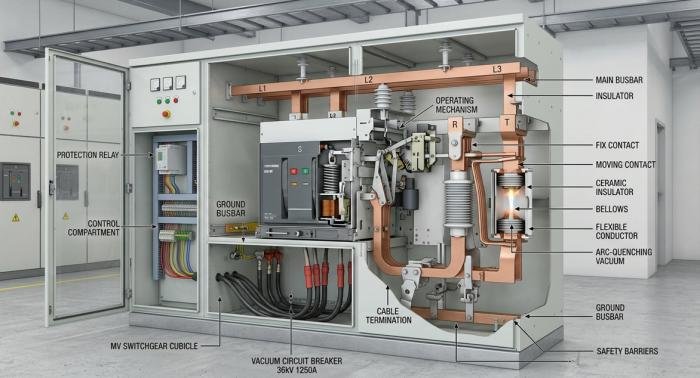
The vacuum interrupter is the main component responsible for interrupting current. It consists of a sealed insulating envelope, stationary and moving contacts, metallic shields, and a bellows assembly.
The high-vacuum environment allows the arc to extinguish quickly and helps restore insulation between the contacts.
2. Fixed Contact
The fixed contact remains stationary inside the vacuum interrupter. It provides one side of the electrical current path and forms a contact interface with the moving contact when the breaker is closed.
Its material and shape influence electrical conductivity, arc behavior, contact erosion, and the overall interrupting performance.
3. Moving Contact
The moving contact travels toward or away from the fixed contact during opening and closing operations. It is connected to the external operating mechanism through an appropriate linkage.
The moving contact must maintain proper alignment and contact pressure to ensure dependable electrical performance.
4. Operating Mechanism
The operating mechanism provides the force required to open and close the contacts. It may use stored-energy springs, a motor-charged spring mechanism, or another suitable mechanical arrangement.
The mechanism must open the contacts quickly enough to meet the breaker’s operating requirements.
5. Insulating Enclosure
The insulating enclosure supports electrical insulation between live components and grounded structures. Depending on the design, it may use epoxy resin, porcelain, or other suitable insulating materials.
The enclosure also helps maintain appropriate clearances between energized parts.
6. Metallic Shield
Metallic shields surround parts of the contact assembly within the interrupter. They help control the distribution of metal vapor produced during arcing and reduce the risk of unwanted deposits on the insulating enclosure.
7. Bellows Assembly
The bellows is a flexible metallic component that permits the moving contact to travel while preserving the vacuum seal. Its condition is important because loss of vacuum can seriously reduce the interrupter’s ability to extinguish an arc.
8. Control and Protection System
The control system includes auxiliary contacts, trip and close circuits, protective relays, interlocks, and status indicators. These components support safe operation, remote control, fault detection, and coordination with the wider electrical installation.
Types of Vacuum Circuit Breakers
Vacuum circuit breakers can be classified according to their installation method, operating mechanism, and intended application. Selecting the correct type depends on the system voltage, rated current, fault level, available space, and operating requirements.
1. Indoor Vacuum Circuit Breaker
An indoor vacuum circuit breaker is designed for installation inside electrical switchgear, control rooms, industrial buildings, and distribution substations.
These breakers are commonly installed in metal-clad switchgear panels or withdrawable switchgear assemblies. Their construction allows them to operate in a controlled environment where exposure to rain, direct sunlight, and severe outdoor weather is limited.
Indoor vacuum circuit breakers are frequently used in factories, commercial buildings, hospitals, data centers, and industrial power distribution systems.
Their main benefits include compact construction, convenient integration with protection systems, and accessibility for inspection and maintenance.
2. Outdoor Vacuum Circuit Breaker
An outdoor vacuum circuit breaker is designed to withstand environmental conditions such as temperature changes, moisture, dust, and solar exposure within its specified operating limits.
It may be installed in outdoor substations, distribution networks, and utility switching installations. The equipment generally includes weather-resistant insulation, suitable enclosures, and mounting arrangements.
Outdoor vacuum circuit breakers are selected when reliable switching and fault interruption are required outside buildings.
The installation must account for pollution levels, altitude, humidity, lightning exposure, and the manufacturer’s environmental ratings.
3. Spring-Operated Vacuum Circuit Breaker
A spring-operated vacuum circuit breaker uses stored mechanical energy to operate its contacts. A motor or manual charging mechanism stores energy in a spring, which is released when an opening or closing command is issued.
This design is widely used because it provides consistent mechanical operation and can be integrated with automatic protection and control systems.
Spring-operated breakers are suitable for applications requiring frequent switching, reliable fault interruption, and remote operation.
4. Magnetic Actuator Vacuum Circuit Breaker
A magnetic actuator vacuum circuit breaker uses electromagnetic force to move the operating mechanism. Depending on the design, magnetic force and stored mechanical energy provide the movement needed for opening and closing.
These breakers may feature fewer moving mechanical parts than some traditional mechanisms. Their performance, operating life, and maintenance requirements depend on the specific design and manufacturer’s specifications.
Magnetic actuator mechanisms can be useful in installations where dependable operation and reduced mechanical complexity are priorities.
5. Fixed-Type Vacuum Circuit Breaker
A fixed-type vacuum circuit breaker is permanently installed within a switchgear compartment. It is not designed to be routinely withdrawn from the panel for maintenance or replacement.
This arrangement can be appropriate for installations where the equipment configuration is expected to remain stable and the maintenance strategy supports fixed installation.
Maintenance may require additional isolation procedures and more work to access or replace the breaker.
6. Withdrawable Vacuum Circuit Breaker
A withdrawable vacuum circuit breaker is mounted on a carriage or racking mechanism that allows it to move between defined positions, such as connected, test, and disconnected.
The connected position permits normal electrical operation. The test position supports certain functional checks while the main circuit is isolated, subject to the switchgear design and interlocking arrangements. The disconnected position provides separation from the main circuit.
Withdrawable designs can simplify maintenance and replacement, especially in industrial switchgear installations where minimizing outage duration is important.
The racking procedure must follow the manufacturer’s instructions and the switchgear’s safety interlocks.
7. Generator Vacuum Circuit Breaker
A generator circuit breaker is designed for switching duties associated with generators. Some generator circuit breakers use vacuum interruption technology, depending on the generator rating and system requirements.
These applications can involve high continuous currents, substantial transient recovery voltages, and demanding short-circuit conditions. Therefore, a breaker intended for ordinary distribution service should not automatically be considered suitable for generator switching.
The selected equipment must meet the generator’s specific electrical and mechanical duty requirements.
Technical Specifications of a Vacuum Circuit Breaker
Before selecting a vacuum circuit breaker, engineers must review its electrical and mechanical ratings. These specifications determine whether the device can safely carry normal current and interrupt the fault currents that may occur in the installation.
The following table summarizes important parameters.
| Parameter | Description | Why It Matters |
| Rated voltage | Maximum system voltage for which the breaker is designed | Ensures suitable insulation and switching performance |
| Rated current | Current the breaker can carry continuously under specified conditions | Prevents excessive heating during normal operation |
| Rated short-circuit breaking current | Maximum specified fault current the breaker can interrupt under defined test conditions | Determines fault-clearing capability |
| Rated short-time withstand current | Current the closed breaker can withstand for a specified short duration | Supports protection coordination and delayed fault clearing |
| Rated peak withstand current | Peak current the breaker can withstand under specified conditions | Addresses electrodynamic forces during faults |
| Operating time | Time required for the mechanism to perform a specified operation | Affects system protection and switching performance |
| Mechanical endurance | Number of mechanical operating cycles supported under defined test conditions | Helps estimate service life and maintenance requirements |
| Insulation level | Specified ability to withstand power-frequency and impulse voltages | Supports safe operation under electrical stress |
| Operating mechanism | Spring, magnetic actuator, or another specified arrangement | Determines how the contacts open and close |
Applications of a Vacuum Circuit Breaker
Vacuum circuit breakers are widely used in electrical systems that require reliable medium-voltage switching and fault protection. Their applications extend across industrial, commercial, utility, and infrastructure installations.
1. Industrial Power Distribution
Manufacturing plants, processing facilities, and industrial complexes often use vacuum circuit breakers to protect medium-voltage distribution feeders.
These feeders supply power to transformers, motor control systems, production machinery, and other major electrical loads. If a fault occurs, the breaker can disconnect the affected feeder and help prevent damage to connected equipment.
Industrial installations may also use VCBs for switching between different sections of a distribution network.
2. Electrical Substations
Vacuum circuit breakers are used in distribution substations to control and protect feeders, transformers, and bus sections.
Protective relays monitor the network and initiate breaker operation when abnormal conditions occur. The breaker isolates the affected section while allowing unaffected sections to remain in service when the network configuration permits.
The specific application depends on voltage rating, fault level, protection coordination, and the utility’s operating practices.
3. Transformer Protection
Transformers are essential components of electrical distribution systems. A vacuum circuit breaker may be installed on the medium-voltage side of a transformer to provide switching and short-circuit protection as part of a coordinated protection arrangement.
The protection system must account for transformer inrush current, winding faults, downstream faults, and the characteristics of any fuses or relays used in the installation.
A VCB does not replace every form of transformer protection. Differential protection, temperature monitoring, pressure protection, and other devices may also be necessary depending on transformer size and design.
4. Motor Protection
Large motors used in industrial plants can require medium-voltage switching equipment. Vacuum circuit breakers may be used to start, stop, and isolate motors when paired with appropriate control and protection systems.
Motor switching can create electrical transients, and the motor’s characteristics may influence contact wear and insulation stress. Engineers should therefore verify that the breaker is suitable for the intended motor-switching duty.
The installation may also require overload protection, earth-fault protection, and monitoring of starting conditions.
5. Power Generation Facilities
Power plants use switching equipment to control auxiliary distribution systems and certain generator-related circuits.
Vacuum circuit breakers may be appropriate for medium-voltage auxiliary feeders, pump motors, fans, and other plant loads. Generator applications require particular care because generator fault currents and transient recovery voltages may differ significantly from ordinary distribution duties.
The equipment must be selected according to the relevant electrical studies and the manufacturer’s application guidance.
6. Commercial Buildings
Large shopping centers, office complexes, hospitals, and other commercial facilities may use medium-voltage distribution systems supplied by utility networks.
Vacuum circuit breakers can protect incoming feeders and transformer circuits, supporting the safe distribution of electricity throughout the building.
Their compact construction can be beneficial where electrical rooms have limited space, provided the required working clearances and ventilation arrangements are maintained.
7. Renewable Energy Installations
Solar power plants, wind farms, and associated collection substations may use vacuum circuit breakers in medium-voltage switchgear.
They can control and protect collection feeders, transformer circuits, and auxiliary electrical systems. The exact design depends on network voltage, fault contribution, switching frequency, and the characteristics of the generation equipment.
Renewable energy installations may also require specialized protection and coordination because inverter-based sources behave differently from conventional synchronous generators during faults.
8. Railway and Transportation Systems
Some railway power distribution installations and transportation infrastructure use vacuum circuit breakers in suitable medium-voltage auxiliary or distribution circuits.
They may protect station supplies, facility feeders, and equipment serving tunnels, depots, or maintenance buildings. Traction-power applications require equipment specifically rated for the relevant supply characteristics and switching conditions.
The selected breaker must meet the applicable railway standards and system-specific requirements.
Advantages of a Vacuum Circuit Breaker
Vacuum circuit breakers offer several practical advantages that make them suitable for many modern electrical installations.
1. Fast Arc Extinction
The vacuum interrupter extinguishes the arc rapidly when the current reaches an appropriate zero crossing in an alternating-current circuit. Rapid interruption helps limit the duration of fault current and reduces electrical stress on the system.
2. Low Routine Maintenance
Vacuum interrupters are sealed units and generally require less routine attention to the arc-quenching medium than oil-filled equipment.
Maintenance is still necessary for the operating mechanism, auxiliary circuits, insulation, contact wear indicators, and other components, according to the manufacturer’s schedule.
3. Long Service Life
When operated within their specified ratings and maintained correctly, vacuum circuit breakers can provide a long service life. Their mechanical and electrical endurance depends on the design, switching duty, fault history, and operating environment.
4. No Arc-Quenching Oil
A vacuum circuit breaker does not require oil for arc extinction. This removes the need for oil-level monitoring and reduces the fire and spill hazards associated with oil-based interruption systems.
5. Compact Design
Many vacuum circuit breakers have a compact interrupter assembly, allowing them to be integrated into modern switchgear panels. This can help reduce equipment space requirements.
6. Reliable Switching Performance
Vacuum interruption technology is widely used in medium-voltage switchgear because it can provide dependable operation when correctly selected, installed, and maintained.
7. Environmentally Practical Operation
Vacuum circuit breakers do not use sulfur hexafluoride gas or insulating oil as the arc-quenching medium. This can simplify certain environmental management requirements compared with equipment using those substances.
However, the full environmental impact still depends on materials, manufacturing, service life, and end-of-life recycling.
Limitations of a Vacuum Circuit Breaker
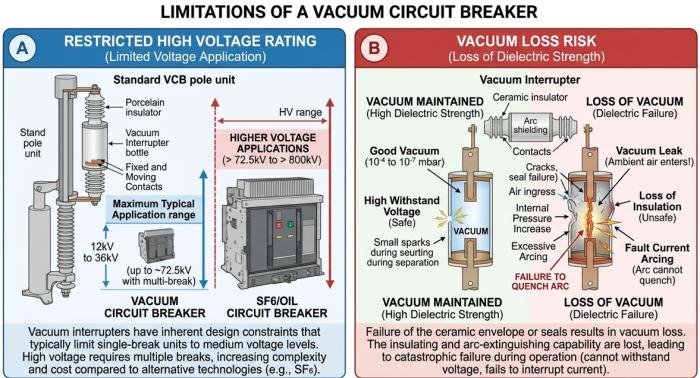
Although vacuum circuit breakers provide many benefits, they also have limitations that should be considered during equipment selection.
1. Higher Initial Cost in Some Applications
The initial purchase price of a vacuum circuit breaker and its associated switchgear may be higher than that of some simpler switching solutions. Total cost should include installation, maintenance, outage requirements, and service life rather than purchase price alone.
2. Specialized Testing Requirements
The sealed vacuum interrupter cannot be assessed solely through an ordinary visual inspection. Suitable vacuum integrity tests, electrical tests, or other manufacturer-approved methods may be required during maintenance.
3. Switching Transients
Certain inductive-load switching operations can produce transient overvoltages or current chopping. These effects depend on the circuit, contact material, load characteristics, and breaker design.
Where necessary, engineers may specify surge arresters, appropriate switching arrangements, or other protective measures.
4. Contact Wear
Repeated switching and fault interruption can erode the contacts. The interrupter’s remaining service life depends on the amount of contact wear and the number and severity of operations.
Contact wear indicators and manufacturer-specified limits must be checked before returning the equipment to service.
5. Application-Specific Selection
Not every vacuum circuit breaker is suitable for every medium-voltage duty. Generator switching, capacitor-bank switching, frequent motor operation, and systems with demanding transient recovery voltages may require specialized designs and additional engineering assessment.
Vacuum Circuit Breaker vs. Other Circuit Breakers
Vacuum circuit breakers are often compared with air circuit breakers, oil circuit breakers, and SF₆ circuit breakers. Each technology has specific applications, ratings, and design characteristics.
| Feature | Vacuum Circuit Breaker | Air Circuit Breaker | Oil Circuit Breaker | SF₆ Circuit Breaker |
| Arc-quenching medium | Vacuum | Air | Insulating oil | Sulfur hexafluoride gas |
| Typical application | Medium-voltage systems | Commonly low-voltage distribution; specialized designs vary | Legacy and selected installations | Medium- and high-voltage applications, depending on design |
| Fire considerations | No arc-quenching oil | No arc-quenching oil | Oil can present a fire hazard | No oil fire hazard from the interrupting medium |
| Routine maintenance | Generally low, but mechanism and interrupter checks remain necessary | Depends on design and application | Includes oil-related inspections where applicable | Includes gas-system checks where applicable |
| Environmental considerations | No SF₆ or arc-quenching oil required | No SF₆ or arc-quenching oil required in conventional designs | Oil handling and disposal must be managed | SF₆ has a very high global warming potential |
| Installation requirements | Suitable vacuum switchgear and insulation coordination | Depends on voltage rating and design | Oil containment and fire precautions may be needed | Gas containment and handling procedures may be needed |
Installation and Maintenance of a Vacuum Circuit Breaker
Correct installation and maintenance are necessary for safe and reliable circuit breaker operation. Even a high-quality vacuum circuit breaker can fail to perform correctly if it is installed improperly or operated outside its rated limits.
1. Installation Checks
Before installation, verify that the breaker matches the switchgear’s rated voltage, continuous current, short-circuit breaking capacity, insulation level, and mechanical arrangement.
Inspect the equipment for shipping damage, loose connections, contamination, and signs of moisture. Check that the mounting structure and electrical connections meet the manufacturer’s requirements.
Verify the operation of interlocks, earthing arrangements, auxiliary contacts, trip circuits, closing circuits, and control wiring before commissioning.
Installation and commissioning should be performed by qualified electrical personnel using approved procedures and appropriate safety precautions.
2. Mechanical Inspection
Inspect the operating mechanism for wear, abnormal noise, damaged linkages, loose fasteners, and incorrect movement.
Check the charging mechanism, opening and closing operations, position indicators, and mechanical interlocks according to the manufacturer’s instructions.
Lubrication should only be performed at the specified points and with approved materials. Excessive or incorrect lubrication can interfere with the mechanism.
3. Electrical Testing
Electrical maintenance may include insulation resistance measurements, contact resistance measurements, timing tests, and functional checks of the trip and close circuits.
The required tests depend on the equipment design, service conditions, applicable standards, and maintenance plan. Test results should be compared with manufacturer specifications and previous measurements where available.
4. Vacuum Integrity Assessment
Vacuum integrity is critical to the interrupter’s ability to extinguish an arc. If the vacuum seal deteriorates, interruption performance and insulation capability may be compromised.
Use only manufacturer-approved vacuum integrity testing procedures. Some tests require specialized equipment and strict isolation arrangements.
A visual inspection alone cannot establish that the interrupter maintains the required vacuum.
5. Record Keeping
Maintain records of switching operations, fault interruptions, inspection findings, electrical test results, repairs, and component replacements.
These records help identify developing problems and support decisions about maintenance intervals or replacement.
A breaker that has interrupted a severe fault may require additional inspection or testing before it is returned to service, in accordance with the manufacturer’s instructions and the applicable operating procedure.
Safety Precautions When Using a Vacuum Circuit Breaker
Electrical safety must remain a priority during installation, operation, inspection, and maintenance.
- Isolate the equipment: Follow approved isolation and lockout/tagout procedures before maintenance.
- Verify the absence of voltage: Use properly rated and tested instruments and follow the site’s electrical safety procedure.
- Apply earthing procedures: Establish protective earthing where required by the approved work method.
- Use appropriate PPE: Select personal protective equipment based on the electrical hazards and the applicable safety assessment.
- Follow manufacturer instructions: Observe specified operating limits, test procedures, and maintenance intervals.
- Check interlocks: Never bypass safety interlocks to speed up operation or maintenance.
- Use qualified personnel: Electrical installation and maintenance should be performed by people with suitable training and authorization.
- Assess arc-flash risks: Although the breaker extinguishes an arc within its interrupter, dangerous arc-flash energy can still occur elsewhere in the switchgear during faults or equipment failure.
How to Select the Right Vacuum Circuit Breaker
Choosing the correct vacuum circuit breaker requires an assessment of both electrical requirements and installation conditions.
First, identify the system’s nominal and maximum operating voltage. The breaker must have an appropriate rated voltage and insulation level for the network.
Second, calculate or obtain the prospective short-circuit current at the installation point. The breaker’s interrupting rating must be sufficient for the expected fault current under the relevant system conditions.
Third, confirm the continuous current rating. The breaker must carry the normal load current without exceeding its specified temperature limits.
Fourth, identify the intended switching duty. Applications involving motors, transformers, capacitor banks, generators, or frequent switching may require additional technical checks.
Fifth, select a suitable installation configuration, such as fixed or withdrawable construction, and determine whether indoor or outdoor equipment is required.
Conclusion
A vacuum circuit breaker plays an important role in maintaining the safety, reliability, and efficiency of electrical power systems. Its ability to interrupt fault currents quickly, minimize routine maintenance, and operate without insulating oil makes it suitable for many medium-voltage applications. By understanding the different types of vacuum circuit breakers, their working principles, technical specifications, and practical uses, engineers and technicians can make better decisions when selecting and maintaining electrical protection equipment.
Proper installation, regular inspection, and compliance with manufacturer recommendations are essential to ensure long-lasting performance and dependable circuit protection.
FAQS
Q: What is a vacuum circuit breaker?
Ans: A vacuum circuit breaker is an electrical switching and protection device that interrupts current by separating contacts inside a sealed vacuum interrupter. The vacuum helps extinguish the arc and restore insulation between the contacts. It is widely used in medium-voltage power distribution systems.
Q: What is the working principle of a vacuum circuit breaker?
Ans: A vacuum circuit breaker operates by separating its moving and stationary contacts when an opening command is received. An arc forms briefly due to metal vapor released from the contact surfaces. In an alternating-current system, the arc is extinguished around a current zero, and the vacuum gap quickly regains dielectric strength.
Q: What are the main types of vacuum circuit breakers?
Ans: Common classifications include indoor and outdoor vacuum circuit breakers, fixed and withdrawable designs, spring-operated mechanisms, and magnetic actuator mechanisms. Generator circuit breakers using vacuum interruption technology are also available for suitable applications. The correct type depends on the electrical duty and installation requirements.
Q: Where is a vacuum circuit breaker used?
Ans: Vacuum circuit breakers are used in industrial plants, electrical substations, commercial buildings, transformer protection systems, medium-voltage motor circuits, power generation facilities, renewable energy installations, and selected transportation systems.
Q: What are the advantages of a vacuum circuit breaker?
Ans: Major advantages include fast arc extinction, low routine maintenance, compact construction, reliable switching performance, and the absence of arc-quenching oil or SF₆ gas. Actual performance and lifecycle cost depend on the design, installation, switching duty, and maintenance practices.
Q: What is the difference between a vacuum circuit breaker and an SF₆ circuit breaker?
Ans: A vacuum circuit breaker uses a sealed vacuum interrupter to extinguish the arc, while an SF₆ circuit breaker uses sulfur hexafluoride gas. Vacuum technology is widely used in medium-voltage equipment, whereas SF₆ technology has been used in medium- and high-voltage applications. Environmental requirements and the specific electrical duty influence the selection.
Q: Does a vacuum circuit breaker require regular maintenance?
Ans: Yes. Although routine maintenance requirements are generally low, the operating mechanism, electrical connections, insulation, control circuits, contact wear, and vacuum interrupter condition must be assessed according to the manufacturer’s schedule and service conditions.