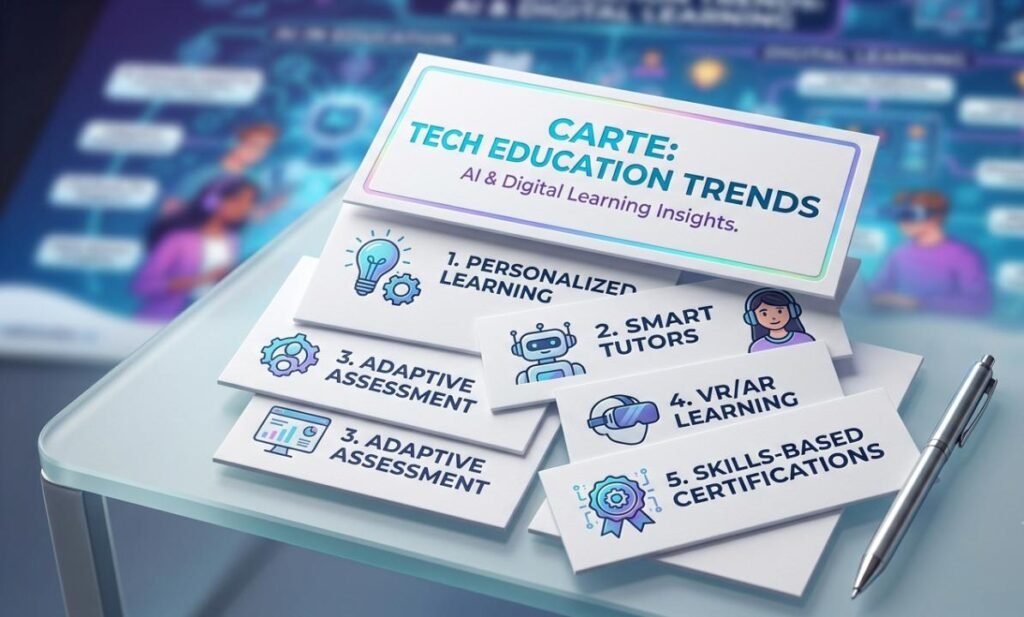

Education is evolving faster than ever as artificial intelligence (AI), cloud computing, data analytics, and digital learning platforms reshape how people teach and learn. Schools, universities, businesses, and governments are investing in educational technology (EdTech) to improve access, personalize learning experiences, and prepare learners for an increasingly digital economy. The phrase droven io tech education trends represents the broader movement toward technology-enabled education and the innovations influencing learning in 2026.
While the term itself is emerging, the underlying trends are supported by research and initiatives from organizations such as UNESCO, the OECD, the International Society for Technology in Education (ISTE), the World Economic Forum, and leading universities. These organizations consistently highlight AI, digital literacy, adaptive learning, and responsible technology use as major priorities for modern education.
How AI and digital technologies are transforming classrooms, explores the opportunities and challenges facing educators and learners, and explains why these developments matter for the future of education.
Also Read more: FTAsiaEconomy Tech Trend: How Emerging Technologies Are Transforming Business
What Are Droven io Tech Education Trends?
The term droven io tech education trends refers to the technologies, strategies, and innovations that are changing the way education is delivered, managed, and experienced. These trends include AI-powered learning tools, digital classrooms, cloud-based education platforms, virtual learning environments, learning analytics, and immersive technologies such as augmented reality (AR) and virtual reality (VR).
Unlike traditional classrooms that rely primarily on textbooks and lectures, modern learning environments combine technology with evidence-based teaching methods. Students can access learning materials from almost anywhere, collaborate online, receive personalized feedback, and develop digital skills that employers increasingly value.
These trends are not simply about replacing teachers with technology. Instead, they focus on supporting educators, improving learning outcomes, and creating more flexible educational opportunities.
Why These Trends Matter
Technology has become an important part of education for several reasons:
- It expands access to quality learning resources.
- It supports personalized learning experiences.
- It helps teachers manage administrative tasks more efficiently.
- It enables continuous assessment and feedback.
- It prepares students for technology-driven workplaces.
- It encourages collaboration across geographical boundaries.
Governments around the world are also investing in digital education to improve educational equity and prepare future workforces for rapid technological change.
The Current State of Digital Education in 2026
Digital droven io tech education trends has progressed significantly over the past decade. What began as supplemental online learning has become a central component of education systems worldwide. Universities now offer fully online degree programs alongside traditional classroom instruction.
Schools increasingly use learning management systems (LMS), digital assessments, cloud collaboration tools, and AI-powered educational applications. Many organizations have adopted hybrid learning models, combining face-to-face instruction with online activities to provide greater flexibility. Several major developments characterize digital education in 2026:
- Increased adoption of AI-assisted learning
- Greater emphasis on digital literacy
- More personalized educational experiences
- Improved accessibility features
- Stronger cybersecurity measures
- Increased use of learning analytics
Growth of Online Learning
Online learning has become more sophisticated than early video-based courses. Modern platforms now include:
- Interactive quizzes
- AI tutoring
- Real-time collaboration
- Automated feedback
- Virtual laboratories
- Mobile learning applications
These features allow learners to study at their own pace while receiving meaningful support throughout the learning process.
Global Adoption of Educational Technology
Educational technology is no longer limited to universities. Today it supports:
- Primary education
- Secondary education
- Higher education
- Professional certification
- Corporate training
- Government workforce development
- Adult education
- Lifelong learning programs
Countries worldwide continue investing in digital infrastructure to improve educational accessibility and competitiveness.
Artificial Intelligence in Modern Education
Artificial intelligence represents one of the most influential developments within droven io tech education trends. AI systems analyze learning patterns, recommend educational resources, automate repetitive tasks, and provide individualized support for students. Rather than replacing educators, AI helps teachers spend more time on instruction, mentoring, and student engagement.
AI-Powered Personalized Learning
Every student learns differently. Some understand concepts quickly through visual examples, while others benefit from additional practice or alternative explanations. AI-powered learning platforms identify these differences by analyzing:
- Learning speed
- Assessment performance
- Topic mastery
- Study habits
- Areas requiring improvement
Based on this information, educational systems recommend customized lessons, practice exercises, and review materials. This personalized approach helps reduce learning gaps while improving student confidence and motivation.
Intelligent Tutoring Systems
Intelligent tutoring systems simulate one-on-one instruction by providing immediate feedback and adaptive guidance. Unlike static educational software, these systems respond to individual learner behavior. For example, if a student repeatedly struggles with algebraic equations, the system can automatically provide:
- Simpler examples
- Additional explanations
- Interactive exercises
- Practice assessments
Research from leading universities suggests that intelligent tutoring systems can improve learning outcomes when integrated appropriately into classroom instruction.
AI for Assessment and Feedback
Traditional grading often requires significant teacher time. AI-assisted assessment tools can evaluate:
- Multiple-choice tests
- Short-answer responses
- Programming assignments
- Mathematical solutions
- Language exercises
Some systems also generate detailed feedback explaining mistakes and recommending improvement strategies. Teachers remain responsible for evaluating higher-order thinking, creativity, and complex writing, but AI reduces repetitive administrative work.
AI Content Generation for Education
Educational institutions increasingly use AI to assist with content creation. Examples include:
- Practice questions
- Lesson summaries
- Interactive activities
- Revision guides
- Study plans
- Language translations
Educators review and refine AI-generated materials to ensure accuracy, relevance, and alignment with curriculum standards. Responsible implementation emphasizes human oversight rather than full automation.
Droven io tech education trends AI Chatbots and Student Support
AI-powered chatbots provide continuous support outside classroom hours. Students can receive assistance with:
- Course navigation
- Assignment reminders
- Frequently asked questions
- Learning resources
- Administrative procedures
Many universities now integrate conversational AI into student portals, improving accessibility while reducing response times for common inquiries.
Emerging Technologies Changing Education
Although AI receives significant attention, several other technologies are contributing to droven io tech education trends. Together, these innovations create more engaging, flexible, and data-informed learning environments.
Adaptive Learning Platforms
Adaptive learning platforms adjust educational content based on individual learner performance. Instead of presenting identical lessons to every student, adaptive systems personalize instruction by:
- Increasing difficulty after mastery
- Reviewing weaker concepts
- Providing targeted practice
- Monitoring continuous progress
This approach supports differentiated instruction while helping educators identify students needing additional support.
Droven io tech education trends Learning Analytics
Educational institutions increasingly rely on learning analytics to improve teaching quality. Learning analytics involves collecting and analyzing educational data such as:
- Attendance
- Assignment completion
- Assessment results
- Student participation
- Engagement patterns
These insights help instructors identify learning challenges earlier and implement timely interventions. Importantly, responsible use of learning analytics requires strong privacy protections, transparency, and compliance with data protection regulations.
Cloud-Based Learning Systems
Cloud computing has become the foundation of modern digital education. Cloud-based learning systems allow students and teachers to:
- Access learning materials anywhere
- Collaborate in real time
- Store assignments securely
- Share educational resources
- Synchronize work across multiple devices
Cloud technology also simplifies software updates, reduces infrastructure costs, and supports remote learning without requiring expensive local hardware. As educational institutions continue adopting cloud services, they increasingly focus on cybersecurity, identity management, and secure access controls to protect sensitive student information.
Virtual Reality (VR) in Education
Virtual Reality (VR) is becoming a valuable educational tool by creating immersive learning environments that would be difficult or impossible to experience in a traditional classroom. Using VR headsets, students can explore historical landmarks, conduct virtual science experiments, or practice technical skills in safe simulated environments.
For example, medical students can practice surgical procedures without risking patient safety, while engineering students can inspect complex machinery in three-dimensional virtual spaces. Geography and history lessons also become more engaging when learners can virtually visit ancient civilizations or natural landmarks.
Research from universities and educational organizations suggests that VR can improve student engagement and knowledge retention when integrated with effective teaching strategies. However, schools must consider equipment costs, accessibility, and teacher training before implementing VR on a large scale.
Augmented Reality (AR) Learning
which creates a completely virtual environment, Augmented Reality (AR) adds digital information to the real world using smartphones, tablets, or AR-enabled devices. AR helps students visualize difficult concepts through interactive models. Biology learners can examine 3D organs, chemistry students can observe molecular structures, and architecture students can interact with building designs before construction begins. AR supports hands-on learning by encouraging exploration, experimentation, and collaboration. As mobile devices become more capable, AR applications continue expanding across K–12 schools, universities, and vocational education.
Mixed Reality Classrooms
Mixed Reality (MR) combines elements of both VR and AR, allowing digital and physical objects to interact in real time. Although still emerging, MR offers exciting possibilities for education, including:
- Interactive science laboratories
- Engineering simulations
- Healthcare training
- Collaborative design projects
- Industrial workforce education
Mixed reality enables students to work together in shared digital environments while maintaining awareness of their physical surroundings.
Gamification in Education
Gamification applies game design elements to educational activities to increase motivation and participation. Rather than replacing learning with games, gamification uses features such as:
- Achievement badges
- Progress tracking
- Leaderboards
- Learning challenges
- Reward systems
- Interactive quizzes
These elements encourage students to stay engaged while developing problem-solving and critical-thinking skills. Studies indicate that well-designed gamification improves participation, especially when aligned with meaningful learning objectives rather than competition alone.
Mobile Learning
Smartphones and tablets have transformed education into an anytime, anywhere experience. Mobile learning allows students to:
- Watch instructional videos
- Complete assignments
- Participate in discussions
- Access digital textbooks
- Review practice questions
- Join virtual classrooms
This flexibility particularly benefits working professionals, distance learners, and individuals pursuing lifelong education. Educational institutions continue optimizing learning materials for mobile devices to improve accessibility and learner convenience.
Internet of Things (IoT) in Education
The Internet of Things (IoT) connects physical devices through the internet to collect and exchange information. In educational environments, IoT supports:
- Smart classrooms
- Automated attendance systems
- Connected laboratory equipment
- Environmental monitoring
- Campus security
- Resource management
IoT technology helps institutions improve operational efficiency while providing data that supports better decision-making. As IoT adoption grows, cybersecurity and device management remain important priorities.
Blockchain for Academic Credentials
Blockchain technology is gaining attention as a secure method for storing educational records and digital certificates. Traditional academic records often require manual verification. Blockchain enables institutions to issue tamper-resistant credentials that employers and universities can verify more efficiently. Potential applications include:
- Digital diplomas
- Professional certifications
- Academic transcripts
- Lifelong learning records
- International credential verification
Although adoption is still developing, blockchain may significantly improve credential management in the coming years.
Digital Classroom Trends
Modern classrooms extend far beyond physical walls. Digital technologies have created flexible learning environments where teachers and students collaborate both in person and online.
Smart Classrooms
Smart classrooms integrate digital devices with traditional teaching methods. Common technologies include:
- Interactive displays
- Wireless presentation systems
- AI-assisted teaching tools
- Classroom management software
- Digital attendance solutions
These technologies improve communication, simplify lesson delivery, and encourage student participation.
Interactive Whiteboards
Interactive whiteboards replace traditional chalkboards with touch-enabled digital displays. Teachers can:
- Annotate presentations
- Display videos
- Solve problems collaboratively
- Access online educational resources
- Save lesson notes instantly
Interactive displays promote active participation while supporting various teaching styles.
Digital Collaboration Tools
Collaboration has become an essential workplace skill, making digital teamwork increasingly important in education. Cloud-based collaboration platforms allow students to:
- Work on shared documents
- Exchange feedback
- Conduct virtual discussions
- Complete group assignments
- Organize project tasks
These experiences prepare learners for modern professional environments where remote collaboration is common.
Video-Based Learning
Video continues to play an important role in education because it accommodates different learning preferences. Educational videos support:
- Demonstrations
- Recorded lectures
- Skill training
- Laboratory procedures
- Language learning
- Professional development
Students can pause, replay, and review lessons as needed, promoting self-paced learning.
Learning Management Systems (LMS)
Learning Management Systems (LMS) serve as centralized platforms for organizing educational content.An LMS typically provides:
- Course materials
- Assignment submission
- Discussion forums
- Grade tracking
- Online assessments
- Communication tools
Popular LMS platforms have become essential components of schools, universities, and corporate training programs.
Benefits of Droven io Tech Education Trends
The continued adoption of droven io tech education trends offers significant advantages for learners, educators, institutions, and employers.
Better Student Engagement
Interactive technologies encourage active participation rather than passive information consumption. Students engage through:
- Simulations
- Interactive assessments
- Educational games
- Virtual collaboration
- Multimedia content
Higher engagement often contributes to stronger motivation and improved academic performance.
Personalized Learning Experiences
Technology allows instruction to adapt to individual learner needs instead of relying on a one-size-fits-all approach. Personalized education helps students:
- Progress at their own pace
- Focus on weaker subjects
- Receive targeted feedback
- Build confidence through continuous improvement
This flexibility supports both struggling learners and advanced students.
Flexible Education Models
Digital education removes many traditional barriers to learning. Students can study:
- From home
- While working
- Across different time zones
- During career transitions
- Throughout their lives
Flexible learning supports lifelong skill development in rapidly changing industries.
Faster Teacher Workflows
Teachers spend considerable time on administrative responsibilities. Educational technology automates repetitive tasks including:
- Attendance recording
- Quiz grading
- Assignment organization
- Communication
- Performance reporting
Automation allows educators to devote more attention to teaching, mentoring, and student support.
Improved Learning Outcomes
When implemented thoughtfully, educational technology contributes to improved learning outcomes through:
- Immediate feedback
- Continuous assessment
- Personalized instruction
- Increased engagement
- Data-informed teaching decisions
Technology itself does not guarantee success, but it enhances educational effectiveness when combined with quality instruction.
Benefits and Challenges at a Glance
| Area | Benefits | Challenges |
| Artificial Intelligence | Personalized learning, automated feedback, adaptive instruction | Bias, transparency, ethical concerns |
| Digital Classrooms | Flexible access, collaboration, resource sharing | Internet dependence, technical issues |
| Virtual & Augmented Reality | Immersive learning, practical simulations | Hardware costs, accessibility |
| Learning Analytics | Early intervention, performance tracking | Data privacy, responsible use |
| Cloud Computing | Anywhere access, secure collaboration | Cybersecurity and compliance requirements |
| Mobile Learning | Convenience and lifelong learning | Screen fatigue and digital distractions |
Challenges and Limitations
Despite remarkable progress, droven io tech education trends also present important challenges that educators and policymakers must address responsibly.
Data Privacy and Security
Educational platforms collect large amounts of student information, including academic records, behavioral data, and learning progress. Institutions should implement:
- Strong encryption
- Secure authentication
- Transparent privacy policies
- Compliance with applicable data protection laws
- Responsible data governance
Protecting student information remains a fundamental responsibility.
Artificial Intelligence Bias
AI systems depend on training data. If that data contains biases or lacks diversity, AI recommendations may produce unfair or inaccurate outcomes. Educational institutions should regularly evaluate AI systems for fairness, transparency, and accountability while maintaining human oversight.
Digital Divide
Not all learners have equal access to reliable internet connections, modern devices, or digital skills. Closing this digital divide requires continued investment in infrastructure, affordable connectivity, accessible technologies, and digital literacy programs to ensure that technological innovation benefits all learners equally.
Best Practices for Schools and Educators
Successfully adopting droven io tech education trends requires more than purchasing new software or devices. Educational technology delivers the best results when it supports clear learning objectives and is implemented responsibly.
Use AI as a Teaching Assistant
Artificial intelligence should complement, not replace, teachers. AI can automate routine tasks such as grading quizzes, organizing learning materials, and providing instant feedback, allowing educators to spend more time mentoring students, encouraging critical thinking, and addressing individual learning needs.
Invest in Teacher Training
Technology is only effective when educators know how to use it confidently. Continuous professional development helps teachers understand digital tools, classroom technology, AI ethics, cybersecurity practices, and inclusive teaching strategies.
Protect Student Data
Schools should establish strong data governance policies that prioritize student privacy. Educational institutions should choose platforms that follow recognized security standards, use secure authentication, and clearly explain how learner data is collected, stored, and used.
Measure Educational Outcomes
Rather than focusing only on technology adoption, institutions should evaluate whether digital tools improve learning outcomes, student engagement, collaboration, and long-term skill development through evidence-based assessment.
Real-World Applications of Educational Technology

Many organizations worldwide are already applying the principles reflected in droven io tech education trends.
- Schools use AI-powered reading assistants, adaptive mathematics platforms, and digital assessments to personalize instruction.
- Universities provide virtual laboratories, online degree programs, AI-supported research tools, and cloud-based collaboration systems.
- Businesses use digital learning platforms to deliver employee training, professional certifications, and leadership development.
- Governments continue expanding digital education initiatives to improve accessibility, promote digital literacy, and prepare citizens for future workforce demands.
These practical examples demonstrate that educational technology has become an essential component of modern learning rather than an optional enhancement.
The Future of Digital Learning Beyond 2026
Education will continue evolving as technology advances. Several developments are expected to shape the coming years:
- More sophisticated AI learning assistants
- Wider adoption of skills-based education
- Increased use of micro-credentials and digital certificates
- Expansion of immersive learning through AR and VR
- Greater emphasis on cybersecurity and ethical AI
- Improved accessibility for learners with disabilities
- Stronger collaboration between educators and intelligent technologies
Future educational systems will likely combine human expertise with intelligent digital tools to create flexible, inclusive, and lifelong learning experiences.
Expert Recommendations
Education experts generally recommend several principles for responsible technology adoption:
- Select educational technology based on learning outcomes rather than popularity.
- Keep teachers at the center of the educational process.
- Regularly evaluate AI systems for fairness and transparency.
- Invest in digital literacy for both students and educators.
- Prioritize accessibility so every learner can participate.
- Continuously review privacy and cybersecurity practices.
- Encourage critical thinking alongside digital skills.
These recommendations align with guidance published by organizations such as UNESCO, OECD, ISTE, and leading educational research institutions.
Conclusion
The rapid advancement of droven io tech education trends demonstrates that technology is reshaping education at every level. Artificial intelligence, adaptive learning, cloud computing, virtual classrooms, and immersive technologies are creating more personalized, flexible, and engaging learning experiences for students worldwide. However, successful digital transformation depends on thoughtful implementation rather than technology alone. Educators, institutions, policymakers, and technology providers must
Work together to ensure innovation supports meaningful learning while protecting privacy, promoting accessibility, and maintaining high educational standards. As AI and digital learning continue to mature beyond 2026, the most successful educational systems will combine technological innovation with human expertise. By adopting responsible practices and focusing on learner outcomes, schools and organizations can build resilient, inclusive, and future-ready education that prepares individuals for lifelong success in an increasingly digital world.
FAQS about droven io tech education trends
Q1: What are droven io tech education trends?
Ans: Droven io tech education trends refer to emerging technologies and digital innovations influencing modern education, including artificial intelligence, adaptive learning, cloud platforms, learning analytics, virtual classrooms, and immersive learning technologies.
Q2: How is artificial intelligence improving education?
Ans: AI personalizes learning, provides instant feedback, automates routine administrative tasks, supports intelligent tutoring, and helps educators identify students who need additional academic support.
Q3: Can AI replace teachers?
Ans: No. AI is designed to assist educators by handling repetitive tasks and providing personalized support. Human teachers remain essential for mentoring, creativity, ethical guidance, collaboration, and social-emotional learning.
Q4: What are the biggest benefits of digital learning?
Ans: Digital learning improves flexibility, expands educational access, supports personalized instruction, enables collaboration, provides immediate feedback, and encourages lifelong learning opportunities.
Q5: What challenges accompany educational technology?
Ans: Common challenges include data privacy, cybersecurity risks, unequal access to technology, implementation costs, teacher training requirements, and ensuring AI systems remain transparent and unbiased.
Q6: Why is digital literacy important in 2026?
Ans: Digital literacy enables learners to use technology safely, evaluate online information critically, protect personal data, collaborate effectively, and adapt to technology-driven workplaces.
Q7: How can schools successfully implement educational technology?
Ans: Schools should develop clear learning objectives, train educators, select evidence-based technology, monitor educational outcomes, protect student information, and regularly evaluate the effectiveness of digital tools.