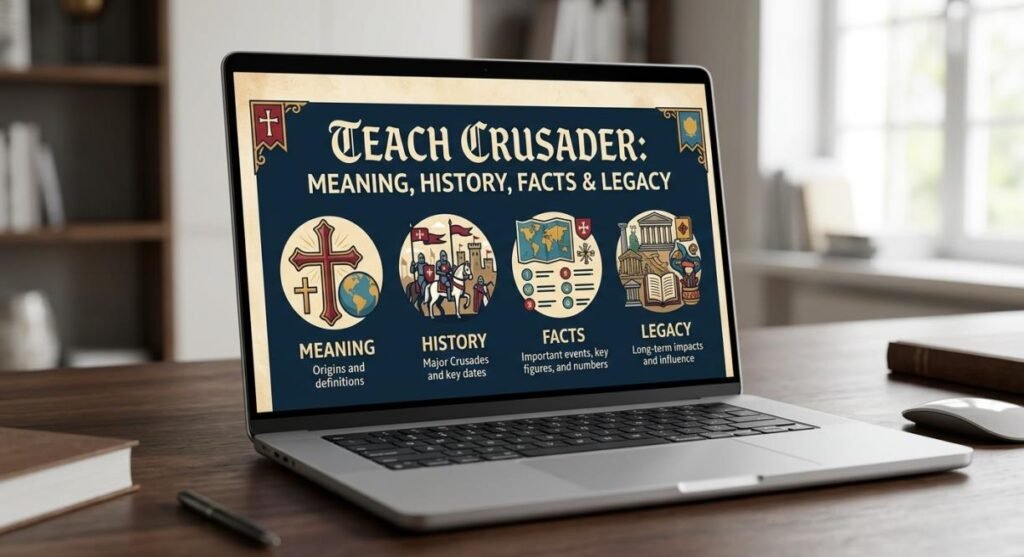

The Crusades are often remembered through dramatic images of armored knights, holy wars, and legendary figures such as Richard the Lionheart and Saladin. But these familiar stories can make a complicated chapter of medieval history seem far simpler than it really was.
Who were the Crusaders, why did they fight, and what impact did their campaigns leave behind? Finding clear answers requires more than memorizing battles and dates—it requires context, evidence, and multiple historical perspectives. Teach Crusader in a clear, balanced way, covering its meaning, origins, major events, key figures, and lasting historical significance.
What Does Teach Crusader Mean?
Teach Crusader is not a standard historical term for a particular medieval person or organization. In an educational or search context, it can reasonably be understood as a request to learn about Crusaders and Crusader history. A Crusader was generally a person who took part in a crusade sanctioned by the Latin Christian Church.
The term is most closely associated with military expeditions connected to the Crusades, particularly those directed toward the eastern Mediterranean. However, the Crusades were not one single war. They consisted of numerous campaigns launched over several centuries, involving different rulers, armies, religious communities, and political objectives.
That distinction is important. A good introduction to Crusader history should not reduce the subject to a simple battle between Christians and Muslims. The historical reality involved competing Christian powers, Muslim dynasties, the Byzantine Empire, local populations, merchants, pilgrims, military orders, and political leaders with changing alliances.
Who Were the Crusaders?
Crusaders came from different parts of medieval Europe and belonged to different social classes. Some were nobles and knights who possessed the resources to travel and fight overseas. Others were ordinary soldiers, pilgrims, clergy, merchants, or people who joined for a mixture of religious, social, political, and personal reasons. The motivations behind participation varied considerably.
Read More: Valinor Shadowfax: Was Shadowfax Allowed to Enter Valinor?
Religious Motivation
Religion was central to the Crusading movement. Many participants believed they were undertaking a religious journey or military expedition connected to Christian holy places. The promise of spiritual benefits was an important part of Crusading culture. Yet religious motivation did not eliminate political ambition, personal interests,teach crusader or economic considerations.
Political Ambition
Medieval rulers and nobles could view Crusading as an opportunity to gain influence, strengthen alliances, increase prestige, or pursue territorial objectives. Political circumstances were particularly important after the First Crusade, when Crusader states were established in the eastern Mediterranean.
Economic and Social Factors
Economic motivations are often exaggerated in popular accounts. It is misleading to assume that most Crusaders joined simply to become wealthy. Overseas expeditions were expensive and dangerous. Knights had to finance equipment, horses, transportation, food, and other necessities. Historical teaching resources emphasize that participation could represent a substantial financial burden rather than an easy path to riches.
When Did the Crusades Begin?
The First Crusade began after Pope Urban II called for an expedition in 1095. The campaign eventually resulted in the capture of Jerusalem in 1099. This event marked a major turning point in relations between Western European Christians and the peoples and political powers of the eastern Mediterranean. The First Crusade was followed by additional Crusades, each shaped by its own political and military circumstances. A simplified timeline looks like this:
| Period | Major Development | Why It Matters |
| 1095 | Call for the First Crusade | Begins the major Western European Crusading movement |
| 1096–1099 | First Crusade | Crusaders capture Jerusalem |
| 1099 onward | Crusader states emerge | New political entities develop in the Levant |
| 1147–1149 | Second Crusade | Major campaign with limited success |
| 1187 | Saladin recaptures Jerusalem | Triggers the Third Crusade |
| 1189–1192 | Third Crusade | Famous confrontation involving Richard I and Saladin |
| 1204 | Fourth Crusade | Crusaders capture and sack Constantinople |
| 1291 | Fall of Acre | Ends major Crusader political control in the Levant |
The First Crusade and the Capture of Jerusalem
The First Crusade is probably the best-known Crusading expedition. After the call for the Crusade in 1095, large groups of Western European participants traveled east. The expedition eventually reached Jerusalem, which was captured in 1099. The conquest had enormous consequences. Crusader leaders established several political entities in the region, commonly referred to as the Crusader states. These included the Kingdom of Jerusalem, the County of Edessa, the Principality of Antioch, and the County of Tripoli.
These states did not exist in isolation. They were surrounded by powerful Muslim rulers and interacted with Byzantine authorities, local Christian communities, merchants, and other regional populations. Modern scholarship has increasingly examined how these states survived despite being relatively isolated and often militarily vulnerable. One recent scholarly teaching series identifies military capability, political skill, divisions among opponents, and external support as important factors in their establishment and survival.
What Were the Crusader States?
The Crusader states were political territories established by Western European Christians in the Levant following the First Crusade. The four principal states were:
Kingdom of Jerusalem
The Kingdom of Jerusalem became the most prominent Crusader state. Jerusalem itself was its symbolic and religious center, although the kingdom’s political and military geography changed over time.
County of Edessa
Edessa was one of the earliest Crusader states. Its position farther north made it particularly vulnerable to surrounding powers. The county fell in 1144, an event that helped stimulate the Second Crusade.
Principality of Antioch
Antioch was strategically important because of its location and its connections to the Byzantine and Islamic worlds. Its rulers had to manage relationships with neighboring Muslim powers as well as the Byzantine Empire and other Christian states.
County of Tripoli
Tripoli represented another important Crusader political center along the Mediterranean coast. Together, these states demonstrate that the Crusades were not simply military expeditions. They produced new political systems, trade relationships, diplomatic arrangements, and cultural interactions.
Why Did the Crusader States Survive?
One of the more interesting questions in Crusader history is how a relatively small Western European elite managed to maintain political control in the region for generations. There was no single answer. Military organization mattered, but so did diplomacy, alliances, local politics, divisions among neighboring powers, and assistance from Europe. The Crusader states also benefited from fortified settlements and strategic coastal positions.
Research-based teaching materials on the subject specifically examine military skill, Muslim political divisions, political leadership, and external support as separate factors rather than treating Crusader survival as the result of military strength alone. This is an important improvement over simplistic accounts of medieval warfare.
Saladin and the Changing Balance of Power
No discussion of Crusader history is complete without mentioning Saladin. Saladin became one of the most important Muslim political and military leaders of the period. He successfully consolidated power across significant parts of the region and challenged the Crusader states. In 1187, his forces defeated the Crusader army at the Battle of Hattin. Jerusalem subsequently returned to Muslim control.
The loss of Jerusalem shocked Western Europe and contributed to the launch of the Third Crusade. This period also produced one of the most famous relationships in medieval history: the rivalry between Saladin and Richard I of England, commonly known as Richard the Lionheart.
Their conflict was serious, but modern portrayals sometimes turn it into a romanticized story of two heroic individuals. The real political situation was more complicated, involving diplomacy, negotiations, military pressure, competing objectives, and regional politics.
Teach crusader the third crusade
The Third Crusade began in response to the Muslim reconquest of Jerusalem. Several powerful European rulers participated or became involved, including Richard I of England. The Crusaders achieved important military successes and regained control of several coastal territories. However, Jerusalem itself was not permanently recaptured. The eventual settlement illustrates an important feature of Crusader history: military campaigns frequently ended through negotiation rather than complete victory by one side. Richard and Saladin reached an agreement that allowed Christian pilgrims access to Jerusalem while leaving the city under Muslim control.
The Fourth Crusade: A Major Turning Point
The Fourth Crusade provides one of the clearest examples of why Crusader history cannot be reduced to a simple Christian-Muslim conflict. Instead of reaching the Holy Land, the Crusaders became involved in Byzantine political disputes. In 1204, Crusader forces captured and sacked Constantinople, the capital of the Byzantine Empire. The event caused deep divisions within the Christian world and severely damaged relations between Western European Christians and Byzantines. It also demonstrates that Crusader armies could become involved in conflicts driven by political and economic interests that differed from the original religious objectives of a campaign.
teach crusader Crusader Military Orders
Another important part of Crusader history is the development of military orders.
Knights Templar The Knights Templar became one of the best-known military orders associated with the Crusades. They combined religious commitments with military responsibilities and developed substantial organizational and financial networks.
Knights Hospitaller
The Hospitallers originally had a strong connection with caring for pilgrims and the sick before becoming an important military organization. Both orders played major roles in the defense of Crusader territories. Their history also demonstrates that medieval institutions could combine religious, military, administrative, and financial functions.
How Should the Crusades Be Taught?
One of the biggest weaknesses in popular explanations of Crusader history is the tendency to present one perspective as the entire story. A better approach is comparative and evidence-based. When teaching Crusader history, students can examine sources from different communities and ask:
- Who created the source?
- When was it written?
- Who was the intended audience?
- What political or religious interests influenced the author?
- What information is missing?
- Does another source tell a different story?
How Did the Crusader States Decline?
The Crusader states faced persistent military and political pressure. Muslim rulers increasingly consolidated power, while Crusader territories remained dependent on complicated alliances and support from Europe.teach crusader final major Crusader stronghold in the Levant, Acre, fell in 1291. The fall of Acre is commonly treated as the end of major Crusader political control in the region. teach crusader Crusading did not simply disappear at that moment. Crusading ideas and campaigns continued in different forms elsewhere, and the concept remained influential in European political and religious culture.
What Did the Crusades Change?
The consequences of the Crusades were broad and sometimes difficult to measure.
Political Change: The Crusades influenced relationships among European kingdoms, the Byzantine Empire, and Muslim powers.
Military Change: Fortifications, military orders, logistics, and siege warfare became important parts of the period’s military history.
Economic and Commercial Connections: The Mediterranean remained a major zone of commercial interaction. Trade networks connected European, Byzantine, and Middle Eastern markets.
Cultural Exchange: The Crusades created opportunities for contact between societies, although those interactions occurred alongside violence and conflict. Historical teaching materials also highlight the movement of knowledge and cultural products between regions, including examples involving mathematics, music, and games.
Why the Crusades Still Matter Today
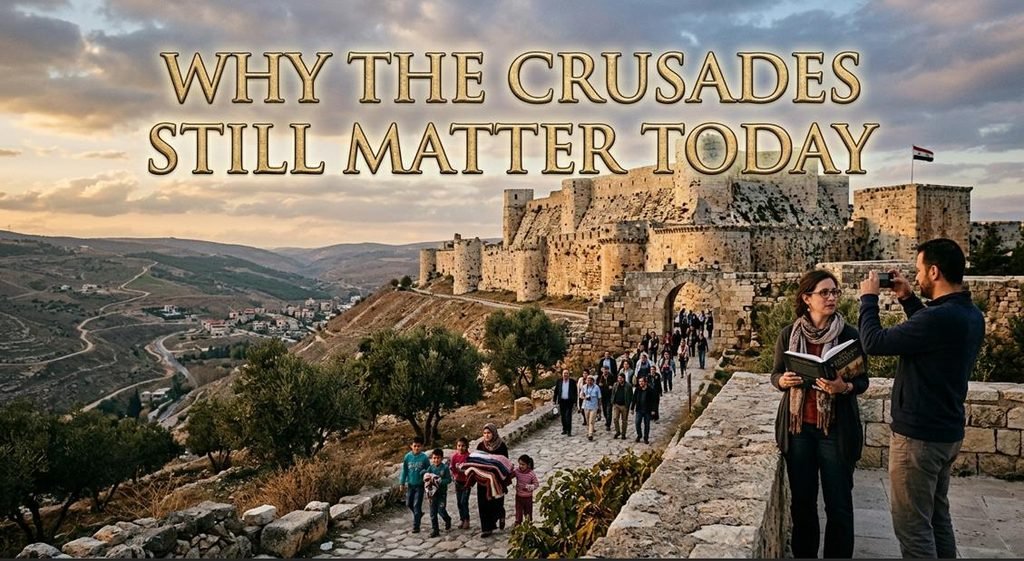
The Crusades remain relevant because their memory has continued to influence modern political and cultural language. Modern political movements sometimes invoke the word “Crusader” symbolically, even when discussing events that occurred many centuries later. This is one reason historical accuracy matters. Medieval terms can acquire new meanings when they are reused in modern political debates. Understanding the original historical context helps readers distinguish medieval events from modern interpretations of those events.
A Better Way to Study Crusader History
Want to learn the subject properly, start with chronology but do not stop there.First, understand the basic timeline. Then examine individual Crusades and the political circumstances behind them. Next, compare sources from different communities.
Consult modern historians and academic works that explain where evidence is strong and where interpretations remain contested. This method is much more reliable than memorizing a list of famous knights and battles. A useful research checklist is:
- Identify the event.
- Establish the date and location.
- Identify the major participants.
- Read more than one account.
- Separate contemporary evidence from later legends.
- Check claims against reputable scholarship.
- Look for perspectives from different communities.
- Distinguish historical fact from interpretation.
Key Facts About Teach Crusader
If you are using Teach Crusader as a search phrase for learning about Crusader history, the most important points are these:
- The Crusades were a series of campaigns rather than one single war.
- The First Crusade began after Pope Urban II’s call in 1095.
- Jerusalem was captured by Crusader forces in 1099.
- Several Crusader states developed in the Levant.
- Saladin recaptured Jerusalem in 1187.
- The Third Crusade followed the loss of Jerusalem.
- The Fourth Crusade resulted in the capture and sack of Constantinople in 1204.
- Military orders such as the Templars and Hospitallers became important institutions.
- Acre fell in 1291, ending major Crusader political control in the Levant.
- Modern scholarship increasingly emphasizes multiple perspectives rather than a simple two-sided narrative.F
Conclusion
teach crusader history can be difficult because popular stories often reduce a complex period to heroes, villains, battles, and religious conflict. That simplified view can hide the political, cultural, economic, and human realities that shaped the Crusades. The solution is to look beyond familiar narratives and examine reliable evidence, historical context, and perspectives from different communities.
This article has provided a clear foundation for understanding the Crusaders, their origins, major campaigns, political states, key figures, and lasting influence. Ultimately, the purpose is not simply to remember dates and battles, but to understand how and why history unfolded—and what it can teach us today.
FAQs about Teach CrusaderF
Q1: What does Teach Crusader mean?
Ans: “Teach Crusader” is not a standard name for a particular medieval figure. In an educational search context, it can be understood as a request to learn about Crusaders, the Crusades, their history, major events, and their wider historical significance.
Q2: Who were the Crusaders?
Ans: Crusaders were participants in medieval Christian Crusades. They came from different parts of Europe and included nobles, knights, soldiers, clergy, pilgrims, and other participants. Their motivations varied and could include religious commitment, political interests, personal goals, and social pressures.
Q3: When did the Crusades begin?
Ans: The First Crusade began after Pope Urban II called for an expedition at the Council of Clermont in 1095. Crusader forces eventually captured Jerusalem in 1099.
Q4: Why did people join the Crusades?
Ans: Motivation differed from person to person. Religious belief was central, while political ambition, social status, family interests, adventure, and other personal considerations could also influence participation. It is therefore misleading to explain every participant’s motivation in exactly the same way.
Q5: Who was Saladin?
Ans: Saladin was a major Muslim political and military leader who united important territories in the eastern Mediterranean and defeated Crusader forces at Hattin in 1187. He subsequently regained Jerusalem.
Q6: What were the Crusader states?
Ans: The Crusader states were political entities established by Western European Christians in the Levant following the First Crusade. The principal states included the Kingdom of Jerusalem, County of Edessa, Principality of Antioch, and County of Tripoli.
Q7: When did the Crusader states end?
Ans: Major Crusader political control in the Levant effectively ended with the fall of Acre in 1291. Crusading continued in other forms after that date, so 1291 should not be interpreted as the end of every Crusading activity.
Q8: Were the Crusades only conflicts between Christians and Muslims?
Ans: No. Although Christian-Muslim warfare was central to many Crusading campaigns, the period also involved conflicts among Christian powers, Muslim political rivalries, Byzantine-Western tensions, diplomacy, trade, and cultural exchange.



Pingback: Bluestock Fintech Internship: Roles, Skills, Eligibility, Opportunities & How to Apply